How Often Should Clinics Recheck Credentials?
Renewal-based checks, monthly exclusion screening, and immediate rechecks after role or location changes prevent billing and compliance gaps.

If I had to boil it down to one rule, it’s this: clinics should recheck each item on the shortest required timeline, run exclusion checks every month, and do an immediate recheck when a provider’s role, privileges, or location changes.
That means I wouldn’t rely on a once-a-year review. Licenses and certifications should be checked by their renewal dates. Core recredentialing usually falls in the 24- to 36-month range. And exclusion screening should happen every month because federal and state lists can change fast.
Here’s the short version:
- Before hire: verify license, training, board status, DEA if needed, and sanctions/exclusions
- Each month: screen OIG LEIE, SAM.gov, and each state Medicaid exclusion list that applies
- At renewal: recheck licenses, board certifications, DEA, and any role-based documents
- Every 24–36 months: complete formal recredentialing based on the shortest payer, state, or accreditor cycle
- Right away after a change: recheck when a provider gains prescriptive authority, starts new procedures, moves to a new state, or has a board complaint or malpractice issue
A simple timing system also helps:
- 90 days before expiration: start follow-up
- 60 days before expiration: confirm progress
- 30 days before expiration: escalate if still incomplete
| Item | Best baseline |
|---|---|
| License | At each renewal date |
| Board certification | At each renewal date |
| DEA | Every 3 years, or sooner after state/location changes |
| Exclusion checks | Monthly |
| Formal recredentialing | Every 24–36 months |
Put plainly: renewal-based checks, monthly exclusion screening, and event-triggered reviews are the three pieces that keep gaps from turning into billing, staffing, or patient-care problems.
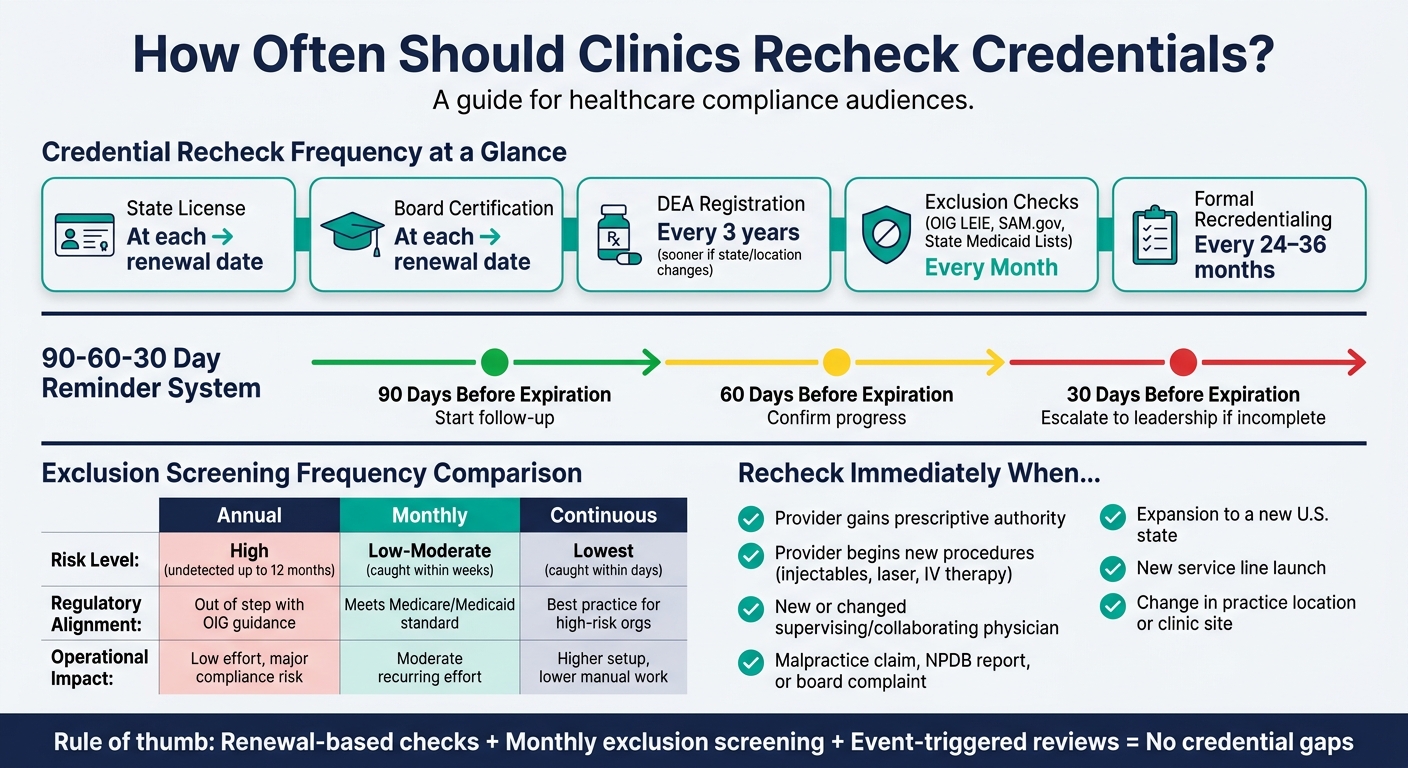
Clinic Credential Recheck Schedule: Frequency, Risk & Compliance Guide
How often clinics should recheck licenses and certifications
After initial credentialing, clinics should recheck each license and certification on or before the renewal or expiration date set by the issuing board or certifying body.
A simple way to stay ahead of deadlines is to use 90-day, 60-day, and 30-day reminders. That gives staff enough time to finish renewals before anything expires. If a renewal is still not done at the 30-day mark, send it to leadership so they can plan coverage. That schedule helps clinics avoid lapses that can interrupt billing and patient care.
Use the shortest required cycle across state, payer, and facility rules
If state, payer, and facility rules don’t match, go with the shortest cycle.
NCQA uses a 36-month cycle, and The Joint Commission allows reappointment no later than 3 years.
The table below shows the default timing clinics can use for each credential type.
| Credential Type | When to Verify | Common External Trigger | Minimum Safe Clinic Frequency |
|---|---|---|---|
| State professional license (RN, NP, MD, PA) | Before hire; at each renewal | State licensing board renewal cycle | At each renewal date |
| Board or specialty certification | Before hire; at each renewal | Certifying body renewal cycle | At each renewal date |
| DEA registration (if applicable) | Before prescribing begins; at renewal | 3-year DEA cycle; location change | Every 3 years or sooner if the provider changes state or work location |
| Core recredentialing | At initial credentialing; every 24–36 months | Payer recredentialing request; accreditation cycle | Every 24–36 months from the last credentialing decision |
Renewal-based checks follow a different timetable than sanctions screening, which requires monthly monitoring.
sbb-itb-02f5876
Reading about the problem? See how Prospyr solves it in one platform.
Book a DemoHow often clinics should run sanctions and exclusion checks
Exclusion lists can change at any time. Because of that, clinics should screen people before their start date and rescreen current staff every month. The OIG updates LEIE monthly, usually around the 20th. That’s why sanctions screening needs its own monthly schedule instead of getting folded into a once-a-year review.
This doesn’t stop with licensed providers. It applies to anyone in clinical, billing, claims, PHI-access, or financial roles.
Monthly screening is the minimum safe baseline for most clinics
For most clinics, monthly screening is the floor. Each monthly check should cover the OIG LEIE and every state Medicaid exclusion list that applies. If a clinic works across more than one state, it needs to check each state list too, not just the federal one. Why? Because a state list may show someone before that person appears on the federal list.
A current staff roster in Prospyr makes it much easier to keep those monthly checks complete and clean.
Monitoring frequency comparison table
| Frequency | Risk Level | Regulatory Alignment | Operational Impact |
|---|---|---|---|
| Annual | High - exclusions can go undetected for up to 12 months | Out of step with OIG guidance and common compliance practice | Low effort, but major compliance risk |
| Monthly | Low to moderate - new exclusions caught within weeks | Meets the standard practice for Medicare/Medicaid billers | Moderate: recurring roster pull, screening, and documentation |
| Continuous monitoring | Lowest - exclusions detected within days of posting | Considered best practice for higher-risk organizations | Higher setup, lower manual work after setup |
Continuous monitoring can flag new exclusions within days of posting, so it gives clinics a tighter safety net than monthly batch screening. It makes the most sense for higher-risk roles and workflows, such as billing staff, revenue cycle teams, pharmacy work, DME workflows, and similar areas where one miss can turn into a billing problem fast.
For many small and mid-sized clinics, though, monthly screening is a practical starting point that lines up with compliance expectations. Then, as the program grows up a bit, continuous monitoring becomes the next move.
Monthly screening covers routine checks. But if someone changes roles, gets new privileges, or starts working at a new location, that should trigger an immediate recheck.
When clinics should recheck credentials outside the normal schedule
Scheduled reviews help, but they won't catch every change as it happens. That's why clinics also need trigger-based rechecks when a provider's role, privileges, or location changes.
Role changes, new privileges, and adverse events
Any provider role change should trigger an immediate recheck. Say an RN is about to start laser hair removal. Before that work begins, the clinic should verify scope of practice, training, clinical privileges, and malpractice coverage.
The same rule applies when a nurse practitioner gains prescriptive authority. Before that provider writes a single prescription, re-verify the state license, confirm any needed DEA registration and state controlled-substance registration, and review collaboration agreement rules.
Adverse events should also trigger an immediate review. If a clinic receives a board complaint or faces a malpractice claim, it should immediately re-verify licensure status, run sanctions and exclusion screening again, and review clinical privileges. Privileges should be restricted until the matter is resolved.
New states and new service lines before launch
Expanding into a new state means starting a new credential check for every provider involved. Before launch, confirm active licensure, delegation and supervision rules, any exclusion lists that apply, and malpractice coverage for that state.
The same goes for new service lines, such as hormone optimization, IV vitamin therapy, advanced laser resurfacing, or similar additions. Clinics should verify that current providers' licenses and scope of practice cover the new services, confirm procedure-specific training, update clinical privileges with medical director approval, and make sure malpractice coverage applies to the new procedures before launch.
Trigger-event checklist table
| Trigger Event | Required Rechecks | Responsible Owner |
|---|---|---|
| Provider gains prescriptive authority | State license, DEA registration, state controlled-substance registration, collaboration agreement, malpractice coverage | Credentialing lead, medical director |
| Provider begins new procedures (injectables, laser, IV therapy) | License and scope-of-practice verification, training/certification records, clinical privilege update, malpractice coverage | Credentialing lead, medical director |
| New or changed supervising/collaborating physician | Licenses of both parties, updated supervision agreement, payer enrollment records, privilege alignment | HR, credentialing lead |
| Malpractice claim, NPDB report, or board complaint | License status, sanctions/exclusion checks, NPDB query, clinical privilege review | Compliance officer, medical director |
| Expansion to a new U.S. state | State licensure, scope-of-practice rules, telehealth registrations if applicable, DEA registration, exclusion checks, malpractice coverage | Credentialing lead, compliance officer |
| New service line launch | License and scope review, training/certifications, privilege update, malpractice endorsement, sanctions check for key providers | Medical director, credentialing lead |
| Change in practice location or clinic site | State license validity for the new location, supervision agreements, payer credentialing update | HR, credentialing lead |
Assign one owner to each recheck and document the result. Prospyr can keep provider records, task assignments, and recheck logs in one place.
These triggers fall apart if no one owns the task or records what happened.
Building a recheck system clinics can actually follow
Assign owners, set reminders, and document each recheck
Once the recheck schedule is in place, clinics need one central tracker for each provider’s licenses, certifications, privileges, sanctions status, and next due date. Spreadsheets and long email chains may seem fine at first, but they’re easy to lose track of. And when renewal or screening dates shift, those gaps can turn into missed steps.
Clear ownership is what turns a deadline into a finished task. Assign one person to complete each recheck and one leader to approve it. In smaller clinics, that’s often the practice manager and medical director. The setup can vary, but it helps to put it in writing so no one is left guessing when staff roles change.
On the calendar side, connect renewals to 90-, 60-, and 30-day alerts. Set monthly tasks for sanctions screening too. Event-based alerts matter as well. If someone changes roles, the clinic adds a new service line, or the business starts working in a new state, those events should trigger a recheck. But those alerts should sit next to calendar reminders, not take their place.
For every finished recheck, document:
- who ran it
- when it was done
- what source was reviewed
- what the result was
If there’s a follow-up step, record that too. Prospyr can support this operational layer for aesthetics and wellness clinics by centralizing staff records and generating recurring recheck tasks.
FAQs
Is an annual credential review enough?
No. An annual review alone isn't enough.
Some tasks, like HIPAA training and facility policy reviews, happen once a year. But clinics should run full credential and license audits at least every quarter.
Licenses should also be checked with the state board at each renewal. That's because expiration dates can vary by provider and by state.
Who needs monthly exclusion checks?
Healthcare organizations need monthly exclusion checks to help make sure they don't employ providers who have been sanctioned by federal healthcare programs.
State and federal databases change often. That's why monthly checks matter. They help lower the risk of legal penalties, regulatory audits, and possible exclusion from programs like Medicare and Medicaid. If an organization fails to screen sources such as the LEIE, it can face fines of more than $130,000.
What changes require an immediate recheck?
Immediate credential rechecks are needed any time services, procedures, devices, or protocols change. Update the credentialing file, then confirm any required manufacturer training and documented competency before a provider performs the new service or uses the new technology.
Recheck credentials right away if a patient asks for a new indication, a dose changes in a material way, or an expired license or training record is found. If compliance has lapsed, the provider must stop related medical procedures until it is restored.