Accreditation for Med Spas: Guide 2026
Treat accreditation as a systems project: eligibility, policies, mock surveys, fix delegation/consent/IPC gaps, and ongoing QA.
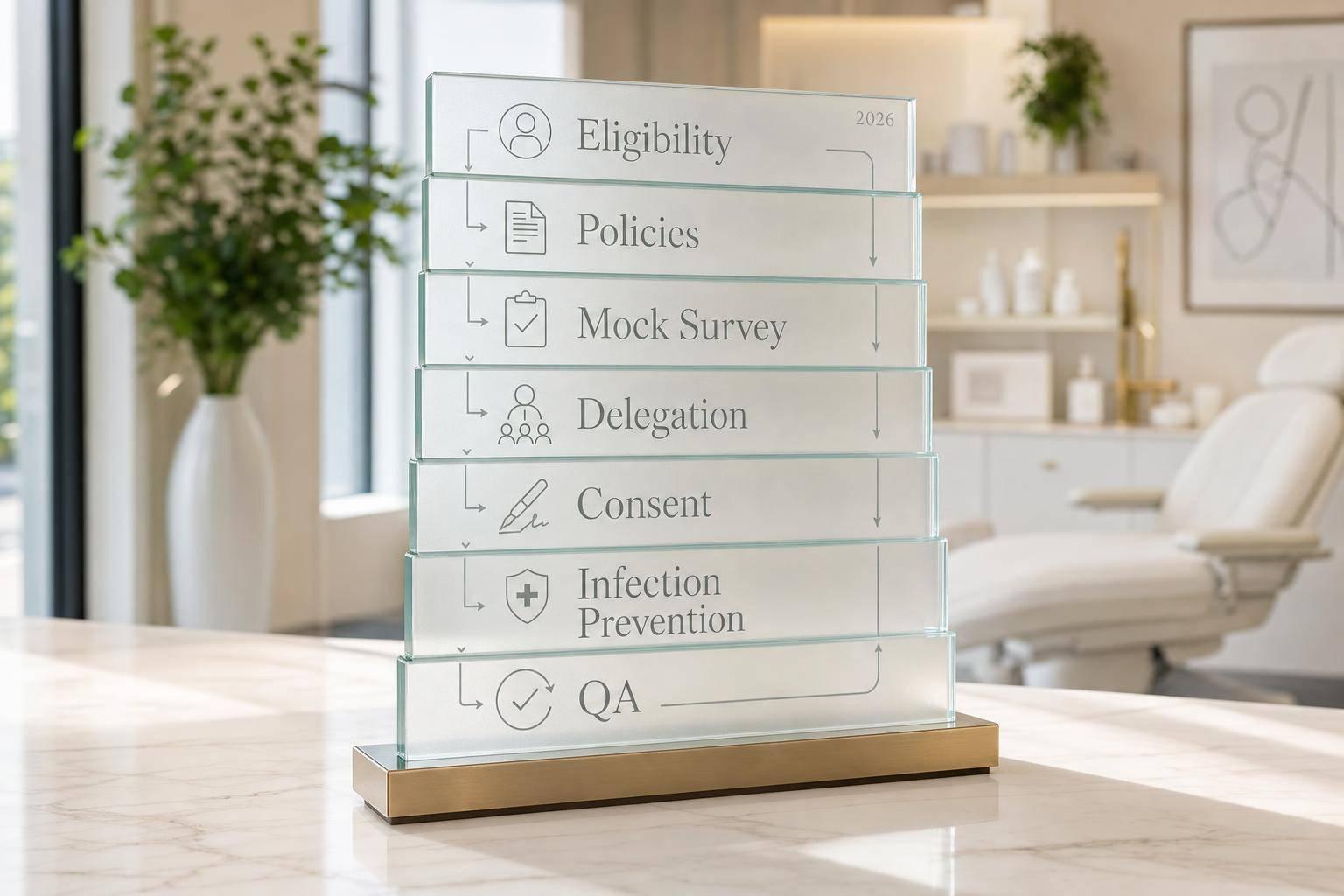

If you run a med spa in 2026, opening a med spa and getting state licensing is only the starting point. Accreditation checks whether your clinic has written policies, staff training, chart controls, emergency drills, infection-control steps, and medical oversight that can hold up under review.
Here’s the short version: accreditation is usually voluntary, often runs on a 3-year cycle, and can take about 60 to 90 days after application once your prep work is done. But the prep stage can take weeks or months, depending on how much is missing. In most med spas, the biggest trouble spots are inactive medical directors, weak delegation records, missing consent details, expired credentials, and poor procedure notes.
If I had to sum up the whole process in a few points, it would look like this:
- Check eligibility first: confirm state licenses, provider licenses, DEA status if needed, device or laser permits, and ownership setup
- Pick the right accreditor: many med spas look at AAAHC, The Joint Commission, AAAASF/QUAD A, or ACHC
- Build proof, not paperwork: surveyors want to see that staff follow policies every day
- Fix common gaps early: charting, consent, infection control, drills, and delegation are frequent weak spots
- Assign owners: medical director, compliance lead, credentialing staff, and front desk all need clear jobs
- Stay survey-ready after approval: annual self-checks, monthly QA review, and current records matter
A simple way to think about it: licensing says you may open; accreditation asks whether you run the practice in a safe, repeatable way.
| Topic | What you need to know |
|---|---|
| Licensing vs. accreditation | Licensing is legal permission; accreditation reviews systems and day-to-day clinic controls |
| Main standards reviewed | Medical oversight, infection control, credentialing, consent, emergency response, documentation |
| Typical prep flow | Gap review → policy updates → staff training → application → survey → correction plan |
| Survey timing | Often ~60–90 days after application, while some fixes may take 30 days or more after findings |
| Main risk areas | Delegation, inactive oversight, missing lot numbers, expired files, drill gaps |
| After approval | Annual self-surveys, file reviews, drill logs, QA meetings, and record retrieval readiness |
Bottom line: if your med spa wants accreditation, I’d treat it like a clinic-wide systems project - not a form-filling task. That mindset is what keeps the process clear, cuts down survey issues, and makes daily compliance easier to maintain.
Med Spa Accreditation Standards and Eligibility in the U.S.
Most med spas look at accreditation through ambulatory care or office-based surgery frameworks. The best fit usually comes down to procedure risk, ownership setup, and whether a given program is recognized in that state.
Accrediting Bodies Med Spas Commonly Consider
AAAHC (Accreditation Association for Ambulatory Health Care) is one of the most common picks for med spas. Its OBS program is geared toward smaller practices with up to four physicians or dentists and no more than two procedure rooms. AAAHC also says practices can comply "in a manner that is compatible with [their] unique situation", which gives smaller cosmetic and wellness practices some room to align the standards with how they operate.
The Joint Commission's Office-Based Surgery Accreditation Program is a better match for office settings that handle higher-risk care or anesthesia-based procedures.
AAAASF (American Association for Accreditation of Ambulatory Surgery Facilities) is centered on office-based surgery and ambulatory surgery facilities.
ACHC (Accreditation Commission for Health Care) can also come into play for ambulatory and specialty outpatient settings.
Core Standards Accrediting Bodies Review
No matter which framework a med spa chooses, the main review areas tend to look pretty similar.
Medical governance and oversight come first. Accreditors expect care to be directed by licensed professionals - MD/DO, APRN, or the state-law equivalent - who take responsibility for clinical services and follow scope-of-practice rules. This becomes a big issue when nurses, PAs, or estheticians perform services through delegation.
Infection prevention and control is another major area. Standards call for written cleaning protocols, disinfection steps for treatment rooms and devices, aseptic technique for injectables, and records that show the practice is following those rules. For med spas, that includes how lasers, RF devices, and similar equipment are cleaned and handled between patients.
Credentialing and privileging focus on verified licensure, documented training, and clear proof that each clinician is qualified for each procedure they perform. AAAHC's v44 standards point to education, experience, competence, licensure, and state law when setting qualifications.
Other review areas include emergency preparedness, medication and device safety, documentation, informed consent, patient rights, and complaint handling. Accreditors also look at device cleaning and reprocessing requirements, along with written policies on patient rights.
Those standards only matter if the practice is already allowed to apply under state law.
Licensing, Registration, and Ownership Prerequisites
Once a practice has a likely accreditor in mind, it needs to make sure the legal groundwork is already in place.
That usually means current state facility licensure or registration, active professional licenses for the clinicians providing care, DEA registration if controlled substances are stored or administered, laser or device permits when state law requires them, and compliant medical-waste handling procedures.
Ownership also matters. In corporate-practice states, a physician or professional medical corporation must own or direct the medical side of the business. Many med spas pair that with an MSO to handle nonclinical operations.
State Requirements vs. Accreditation Expectations
The difference is pretty simple: state rules decide whether the med spa can operate at all, while accreditation looks at whether the practice can show safe systems, trained staff, and documented oversight.
| Area | State Licensing / Registration | Accreditation Expectation |
|---|---|---|
| Facility permits | Required before opening | Must be current at time of application |
| Provider licenses | Required per state board | Verified and documented in credentialing files |
| Laser / device operation | Varies; in California, laser use is treated as the practice of medicine | Operator training and competency documented |
| Medical oversight | Often required by state rule | Formal governance structure, policies, and supervision logs |
| Infection control | Basic sanitation standards | Written protocols, staff training, audit records |
| Emergency preparedness | Rarely detailed in state rules | Written plan, documented drills, staff roles assigned |
| Accreditation itself | Voluntary in many states | Required or incorporated into state rules in some jurisdictions |
California is a good example of where state rules and accreditation expectations line up closely. There, operating a medical laser is defined as the practice of medicine and cannot be delegated to estheticians, LVNs, medical assistants, or unlicensed technicians, regardless of vendor training certificates.
With eligibility nailed down, the next step is getting policies, training records, and audit documentation ready for survey review.
sbb-itb-02f5876
The Accreditation Process: Stages, Timelines, and Internal Audits
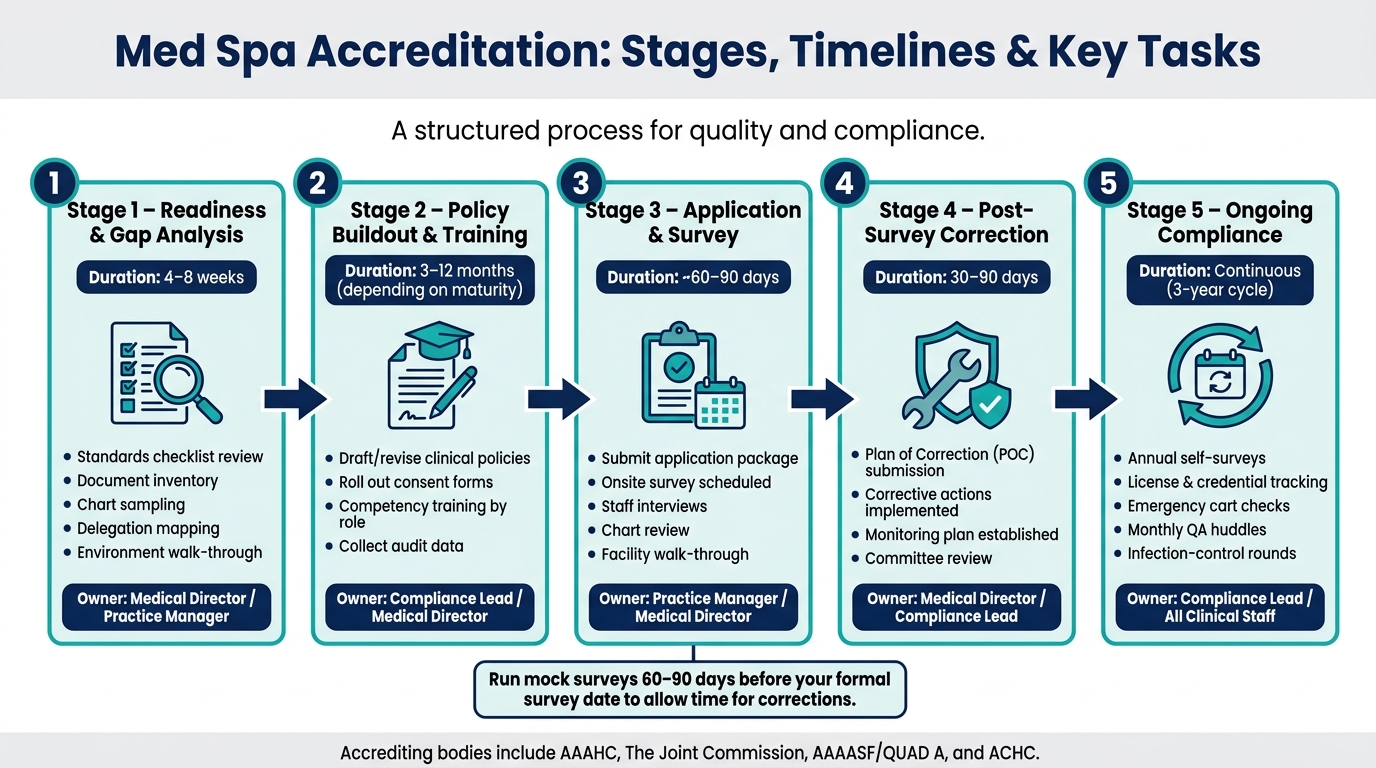
Med Spa Accreditation Process: Stages, Timelines & Key Tasks
Once eligibility is confirmed, the job shifts from checking boxes to showing that the practice follows those standards every day. Accreditation isn't one big moment. It's a step-by-step process with clear stages, each with its own workload and timeline. Most existing med spas move through four phases, then continue with routine compliance work after that: readiness and gap analysis, policy buildout and training, application and survey, and post-survey corrective actions and monitoring.
Readiness Review, Policy Buildout, and Staff Training
The readiness phase is where a practice takes an honest look at where it stands against the accrediting body's standards. In plain English, that means gathering current policies, consent forms, training records, incident logs, and equipment maintenance files, then checking each item against a standards-based checklist. Every patient-care area should be reviewed with the accreditor's checklist before the survey. Delegation should also be mapped out clearly so supervision and scope line up with what staff do each day.
Once the gaps are clear, the next step is policy buildout. This stage includes drafting and putting clinical policies into use, rolling out consent forms, training each clinical role based on job duties, and collecting audit data that shows those policies are being followed in practice.
Surveyors aren't looking for binders that sit on a shelf. They want proof that the policies shape day-to-day care. Personnel files should include completed competency forms, in-service attendance records, and certificates for higher-risk tasks like laser operation or injectable administration. Competency checks also need to happen at set intervals, not just once during onboarding.
Application, Survey, and Plan of Correction
When the policies are in place and the training files are ready, the practice submits the application package. That package includes service descriptions, ownership and governance details, licensure data, and key policies. After that, the accrediting body schedules the onsite survey. AAAASF (now QUAD A) requires at least 30 days from receipt of a completed packet before a survey can be scheduled, though expedited options are available for an added fee.
The survey usually starts with an opening conference. Surveyors explain the schedule and choose sampled patient records, often zeroing in on higher-risk cases. From there, they interview the medical director, review personnel files and patient charts, observe care when appropriate, and walk through the facility to check emergency carts, equipment maintenance logs, signage, and infection-control setups. Staff interviews are part of the process too, since surveyors want to see whether daily protocols are being followed in the real world, not just written down. The survey ends with an exit conference that sums up the findings, but the final accreditation decision comes later from the accrediting body's clinical review team.
After the survey, the practice gets a report listing any deficiencies. The Joint Commission gives organizations 10 business days from the posting of the final survey report to submit Plans of Correction. AAAASF typically allows about 30 days to correct deficiencies before committee review, and in straightforward cases the full process from application to accreditation activation usually takes about 90 days.
A strong Plan of Correction is specific. It should spell out the exact corrective action taken, name the responsible party by title, give a realistic completion date, and explain how the practice will monitor compliance going forward. Vague answers won't cut it. Surveyors want to know what changed, who owns the fix, and how the practice will make sure the change holds.
Internal Audits and Mock Survey Methods
After submission, internal audits keep those same standards active before the survey and between survey cycles. This isn't optional. QUAD A requires each accredited facility to complete a self-survey every year between onsite surveys.
The table below maps each accreditation stage to its key tasks and typical timelines.
| Stage | Key Tasks | Primary Owner | Typical Duration |
|---|---|---|---|
| Readiness & Gap Analysis | Standards checklist, document inventory, chart sampling, delegation mapping, environment walk-through | Medical Director / Practice Manager | 4–8 weeks |
| Policy Buildout & Training | Draft/revise policies, roll out consent forms, competency training, collect audit data | Compliance Lead / Medical Director | 3–12 months depending on maturity |
| Application & Survey | Submit application, document packet, onsite survey, staff interviews, chart review | Practice Manager / Medical Director | ~60–90 days |
| Post-Survey Correction | POC submission, corrective actions, monitoring plan, committee review | Medical Director / Compliance Lead | 30–90 days |
| Ongoing Compliance | Annual self-surveys, license tracking, emergency cart checks, infection-control rounds | Compliance Lead / All Clinical Staff | Continuous; annual self-surveys within the 3-year cycle |
For mock surveys, copy the structure of the formal survey and use the accreditor's actual standards as the guide. Chart audits should include a random sample across procedure types and check for complete histories, signed consents, accurate procedure notes, and documented follow-up. License expiration tracking and emergency cart checks should happen on a fixed schedule, not only when someone remembers or a problem pops up. Incident log reviews can also surface repeat issues that point to system gaps before a surveyor spots them.
Practices that run mock surveys at least 60–90 days before the formal survey date give themselves enough time to fix issues before the onsite review begins.
Reading about the problem? See how Prospyr solves it in one platform.
Book a DemoCommon Roadblocks and How Med Spas Fix Them
Even well-run med spas run into the same accreditation problems. That’s normal. The point of a mock survey is to catch them before the formal review does.
These are usually the first trouble spots that show up.
Gaps in Medical Oversight and Delegation
The most common oversight failure is an inactive medical director. Surveyors want proof that the role is active, not just listed on paper. They look for chart review, complication review, and approved protocols.
Delegation problems tend to show up right after that. Accrediting bodies expect a written delegation matrix that links each procedure to the provider types allowed to perform it, the training required, and the level of supervision needed. A physician being “available” is not enough.
The fix is straightforward: tighten the structure and document it. Put the medical director’s duties in writing, including protocol approval, adverse-event review, staff training, and chart review. Then match each procedure to a provider type, supervision level, and competency check. Review those records at least once a year and any time a new service is added.
Documentation, Consent, Training, and Infection Control Weaknesses
The most common documentation failures are pretty basic, which is what makes them so frustrating: missing lot numbers, incomplete dosage fields, generic consent forms, and no recorded follow-up after adverse events.
Procedure-specific consent forms help a lot. For neurotoxins, dermal fillers, laser treatments, and weight-loss injections, the form should include the risks tied to that service and note off-label use when it applies. That makes it much harder for staff to skip key details. Monthly chart audits by the compliance lead or medical director, with samples across different procedure types, can catch missing signatures and weak notes before a surveyor finds them. Credentialing files should also stay current. Each file should include primary source license verification, current certifications, CME records, and competency checklists, with at least annual review and a tickler system for upcoming expirations.
Infection control is another repeat issue. The IPC program must be approved by the governing body and must spell out cleaning, sterilization, injection safety, and environmental disinfection.
Accreditation Roadblocks: Issues and Corrective Actions
Use the chart below to match each deficiency to its fix.
| Roadblock | Survey Impact | Root Cause | Corrective Action |
|---|---|---|---|
| Absent or inactive medical director | Governance deficiency; delays accreditation | Physician listed but not actively involved | Revise the agreement to define specific duties, review cadence, and complication escalation; document oversight activities |
| Vague or missing delegation matrix | Delegation and scope-of-practice deficiency | No written procedure-to-provider map | Build a procedure-by-procedure delegation matrix tied to state law; review annually and when adding services |
| Incomplete or generic consent forms | Patient safety and documentation finding | Generic consent not tailored to procedure risks | Create procedure-specific consent forms with required fields; audit charts monthly for signed consent on every procedure |
| Missing or expired provider credentials | Credentialing and privileging deficiency | No credential tracker | Maintain a credentialing file per provider; use a tickler system for expiration dates; verify primary source annually |
| Inadequate written IPC program | Infection control deficiency | Generic policy not formally approved | Draft a governing-body-approved IPC program covering sterilization, injection safety, and environmental cleaning; assign an IPC lead |
| Incomplete procedure notes | Clinical record deficiency | No standardized charting template | Implement procedure-specific templates with fields for product, lot number, dose, site, and follow-up |
| Missing adverse-event documentation | Patient safety finding | No incident reporting process | Create a mandatory notification policy; document every adverse event, medical director notification, and corrective action taken |
| Emergency drill gaps | Emergency preparedness deficiency | Drills not scenario-based or not documented | Schedule quarterly scenario-based drills; document participation, evaluations, and improvement actions |
Once those gaps are fixed, the practice can assign clear owners and keep tight control of the records that show compliance.
Team Roles, Document Control, and Compliance Systems
Once you fix the gaps, the next step is simple: give each job a clear owner. If no one owns it, it tends to drift. And in the time between surveys, accreditation often comes down to two things - clear responsibility and records that are up to date.
Who Owns Accreditation Inside the Practice
A practical med spa compliance structure usually includes a medical director, a compliance or accreditation lead, clinical service-line leads, and front-desk/operations staff. Each role should have a defined set of duties.
The medical director handles clinical oversight, delegation, protocol approval, chart review, competency validation, and incident review. Keep signed protocols, chart-review logs, competency sign-offs, and incident reviews together in one current governance file. Update that file every quarter.
The compliance or accreditation lead handles policy version control, internal audits, corrective actions, and survey coordination.
Clinical service-line leads handle procedure-specific competency checklists, equipment logs, and training records for their area. Front-desk and operations staff handle intake workflows, consent capture, scheduling records, and communication records.
Credentialing, Privileging, and Document Control
Credentialing files should include primary source license verification, board certifications, malpractice coverage, disciplinary history, and education or training records for each provider. They should also include monitoring for sanctions over time. A simple habit helps here: audit 100% of credentialing files each year, then spot-check a few files every week so expiration dates don't catch you off guard.
Privileging should be tied to each procedure. The medical director or a credentials committee reviews the provider's training and experience, and the governing body or ownership formally approves privileges for each service type, such as neuromodulators, dermal fillers, and laser treatments. That privileging grid should stay current and be ready for surveyors at any time.
For document control, the goal is one current master file with version history, approval signatures, and staff acknowledgment records. HIPAA-related records - policies, procedures, training logs, risk assessments, sanctions, and audit logs - should usually be kept for at least 6 years from the date they were created or last in effect, whichever is later.
If you use both paper and digital records, you also need a clear retrieval process. During a survey, someone should always be available who can pull records fast.
| Role | Primary Accountability | Key Documents They Own |
|---|---|---|
| Medical director | Clinical oversight, delegation, supervision, and competency validation | Signed protocols, delegation agreements, chart review logs, incident reviews |
| Compliance/accreditation lead | Survey readiness, policy control, and audit coordination | Policy index, version logs, internal audits, corrective actions |
| Privacy/Security Officer | HIPAA privacy and security program | Risk analysis, training logs, incident response, audit logs |
| Credentialing coordinator | Provider file completeness and expiry tracking | License verifications, CE tracking, privileging files, reappointment reminders |
| Clinical service-line lead | Procedure-specific competency and training | Competency checklists, procedure training records, equipment logs |
| Front desk/operations staff | Intake workflow, consent management, and record retrieval | Consent capture, scheduling records, communication records, HIPAA workflows |
Once ownership is clear, the next job is keeping records current, easy to pull, and ready for survey review.
Clear ownership works best when files live in one place and stay current.
Using Prospyr for Compliance Workflows

Centralized workflows make that much easier. A HIPAA-compliant platform like Prospyr can bring intake, digital forms, consent capture, task follow-up, charting, communication, and practice analytics into one system.
Maintaining Compliance and Quality After Accreditation
After accreditation, the job changes. It’s no longer about getting ready for survey day. It’s about staying ready every day.
That matters because accrediting bodies may conduct unannounced monitoring visits after complaints, adverse events, or safety concerns trigger review. In practice, continuous readiness is the standard.
Metrics, Review Cadence, and Annual Updates
Track key metrics on a set schedule. Hold monthly QA huddles to review:
- complications
- near misses
- documentation errors
- training completion
- drill participation
Complete an annual compliance review covering infection control, emergency response updates, and patient, personnel, and credentialing files.
Each QA meeting should end with a clear action item. If complication rates go up or incomplete consents become more common, document the corrective step, name the person responsible, and set a due date. Then use that review to start performance-improvement projects that show baseline data, an intervention, and a re-measurement result.
Use a structured self-assessment at 12 and 24 months to spot gaps and submit corrections before the next survey. Keep drill logs, infection-control checklists, and equipment inspection records up to date and ready for review. After each drill, record the outcome and note any protocol or training changes.
Compliance Tools Mapped to Accreditation Needs
Use systems that make tracking and retrieval less of a scramble. The table below links common platform functions to accreditation needs.
| Accreditation Domain | Practical Tool or Capability | What It Supports |
|---|---|---|
| Patient communication & privacy | Secure email/SMS communication, HIPAA-compliant data security | Timely patient communication and protected information handling |
| Document control | CRM/EMR integration, digital intake forms | Centralized records and easier retrieval of current forms |
| Credential & training tracking | Task management | Follow-up on renewals, training assignments, and compliance deadlines |
| Quality improvement & analytics | Practice analytics dashboards | Trend review, reporting, and performance monitoring |
Prospyr brings together digital intake, task management, analytics, and HIPAA-compliant communication in one system, which can cut down on record fragmentation during survey review.
Conclusion: A Practical Roadmap for Med Spa Accreditation
For most med spas, accreditation follows a simple sequence. First, understand the standards that apply and confirm state-level eligibility before applying. Next, build policies and training early so staff have time to absorb them. Then run internal audits and mock surveys to find gaps before the on-site visit. And just as important, assign clear ownership so nothing slips between surveys.
Handled this way, accreditation becomes part of day-to-day operations.
FAQs
Is med spa accreditation required?
Med spa accreditation is not a universal legal requirement in the United States. In many cases, it’s voluntary.
That said, accreditation sends a clear message: your clinic takes patient safety, day-to-day quality, and regulatory compliance seriously.
And even if your med spa isn’t accredited, the legal bar doesn’t go away. Your clinic still needs proper licensing, internal audits, credentialing, and clean documentation. Miss those basics, and you could face legal trouble, financial penalties, or even license suspension.
How do I choose the right accreditor?
Choose an accreditor that fits how your clinic runs and what your state requires. The best fit usually comes from an agency that matches your type of facility and pays close attention to areas like infection control, clinical safety, and administrative management.
You’ll also want to check that the accreditor’s standards line up with your aesthetic services. That includes OSHA compliance, HIPAA security, and any state-required delegation agreements. Prospyr can help by keeping documents in one place, tracking staff credentials, and maintaining audit-ready records.
What documents should I prepare first?
Start with your core legal and entity documents. These are the backbone of compliance: articles of incorporation, PC or PLLC filings, operating agreements, and bylaws.
Next, pull together your regulatory, clinical, and personnel records. That includes your EIN, business licenses, medical board registrations, physician-approved Standard Operating Procedures, staff licenses, and medical director agreements.
The goal is simple: keep everything organized and easy to access. If an audit happens, you don't want to scramble through folders or chase down missing paperwork.