Virginia Med Spa Insurance Requirements
Virginia med spa insurance checklist: malpractice, general liability, workers' comp (3+ employees), cyber, property, and documentation.
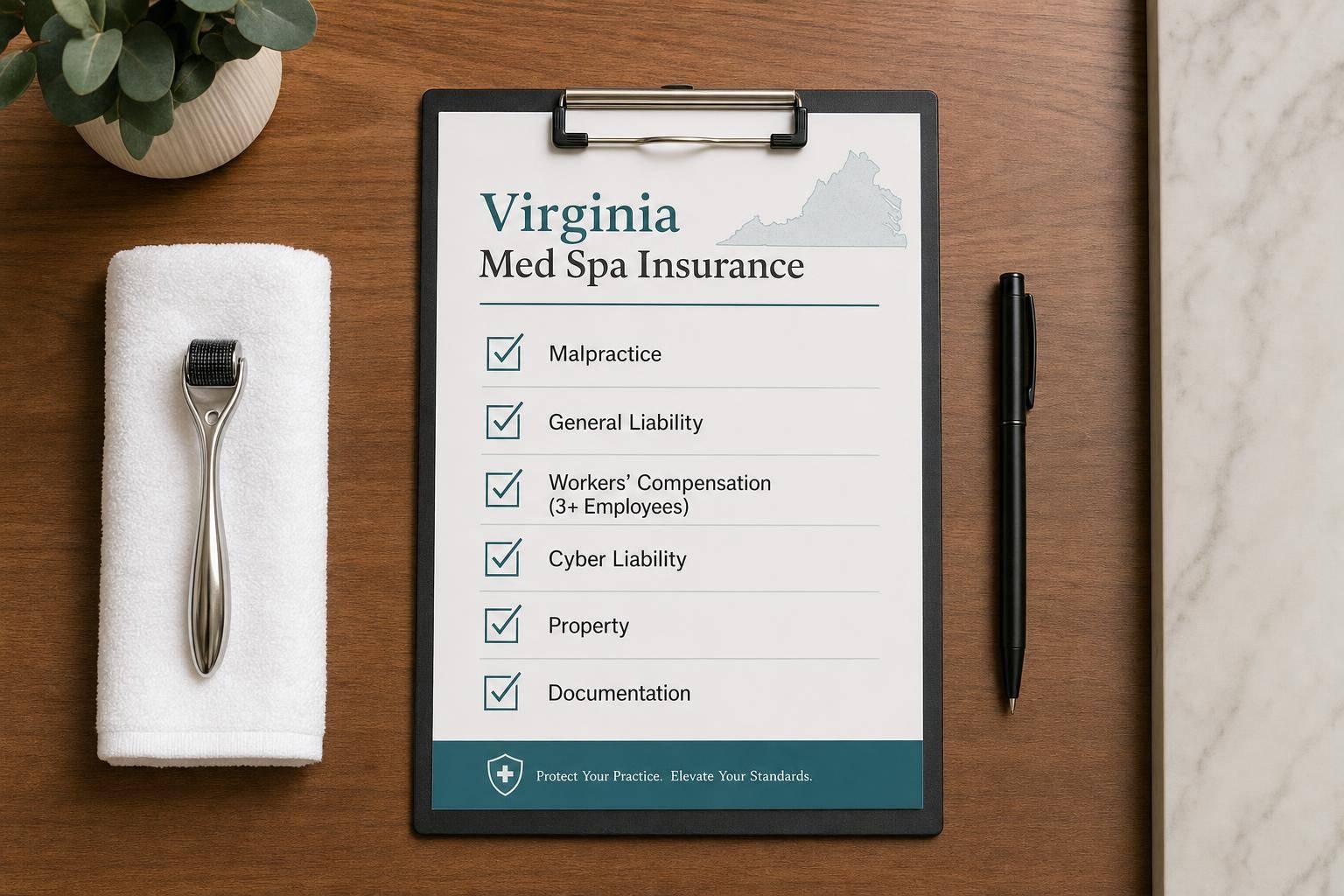

Virginia does not set one blanket insurance rule for med spas, and that’s where many owners get exposed. If I run a med spa in Virginia, I usually need more than a basic business policy: malpractice for treatment claims, general liability for on-site accidents, workers’ comp at 3+ employees, and often cyber, product, umbrella, and EPLI coverage too.
Here’s the short version:
- A BOP is not enough. It may cover property damage and slip-and-fall claims, but not laser burns, injection errors, or other treatment injuries.
- Professional liability and general liability do different jobs. One handles care-related claims; the other handles premises claims.
- The clinic needs its own malpractice policy. A medical director’s policy does not automatically cover the business entity.
- Service mix changes risk. Lasers, deep peels, GLP-1 programs, and hormone services often need higher limits or added policy language.
- Workers’ comp usually becomes required at 3 or more employees in Virginia, including part-time staff.
- Cyber coverage matters if patient charts or payment data are stored online. HIPAA penalties can reach $2,134,831 per violation category, per year.
- Records matter. Consent forms, supervision logs, delegation records, credential files, and treatment notes can affect claim handling.
A few numbers stand out:
- Common malpractice limits: $1,000,000 per claim / $3,000,000 aggregate
- Workers’ comp often costs about $2,000 to $5,000 per year
- EPLI often runs about $800 to $2,000 per year
- A single laser device may cost $50,000 to $200,000
If I had to boil the article down to one point, it would be this: Virginia med spa insurance depends on who owns the clinic, who performs care, and which treatments are offered. That’s why coverage should match the business structure, staff setup, and current service list.
Virginia scope rules that shape coverage decisions
Virginia splits oversight between medicine and cosmetology. Because of that, coverage needs to line up with both the provider’s license and the service being performed. If a treatment falls outside the provider’s scope, an insurer may push back on a claim. So this isn’t just a licensing matter. It can directly affect coverage.
Medical procedures versus non-medical esthetic services
Whether a service counts as medical helps decide which policy should respond: professional liability or general liability.
Medical treatments bring malpractice risk tied to the service itself. Injectables can carry nerve damage risk, laser treatments can carry burn risk, and chemical peels can carry scarring risk. Those services call for professional liability coverage.
Non-medical incidents fall under general liability. A slip-and-fall in the waiting room is a general liability claim, not a malpractice claim.
Every provider who performs medical treatments should have individual or entity malpractice insurance that matches the services offered. It also helps to give your broker a full, current list of every service the clinic provides.
Documentation controls that support compliance and underwriting
Once scope is clear, documentation is what proves it. It backs up scope compliance and gives underwriters what they need to review the risk. That means keeping informed consent forms, supervision and delegation logs, provider credentialing files, treatment notes, and a detailed service menu.
Supervision logs matter a lot here. Insurers often look closely at supervision claims tied to non-physician providers. If physicians or mid-level providers oversee RNs and aestheticians, those relationships should be documented in plain terms and kept up to date.
It also makes sense to centralize intake forms, consents, treatment notes, and audit trails in one digital system. That can make underwriting and compliance requests much easier to handle.
Reading about the problem? See how Prospyr solves it in one platform.
Book a DemoCore insurance policies Virginia med spas typically need
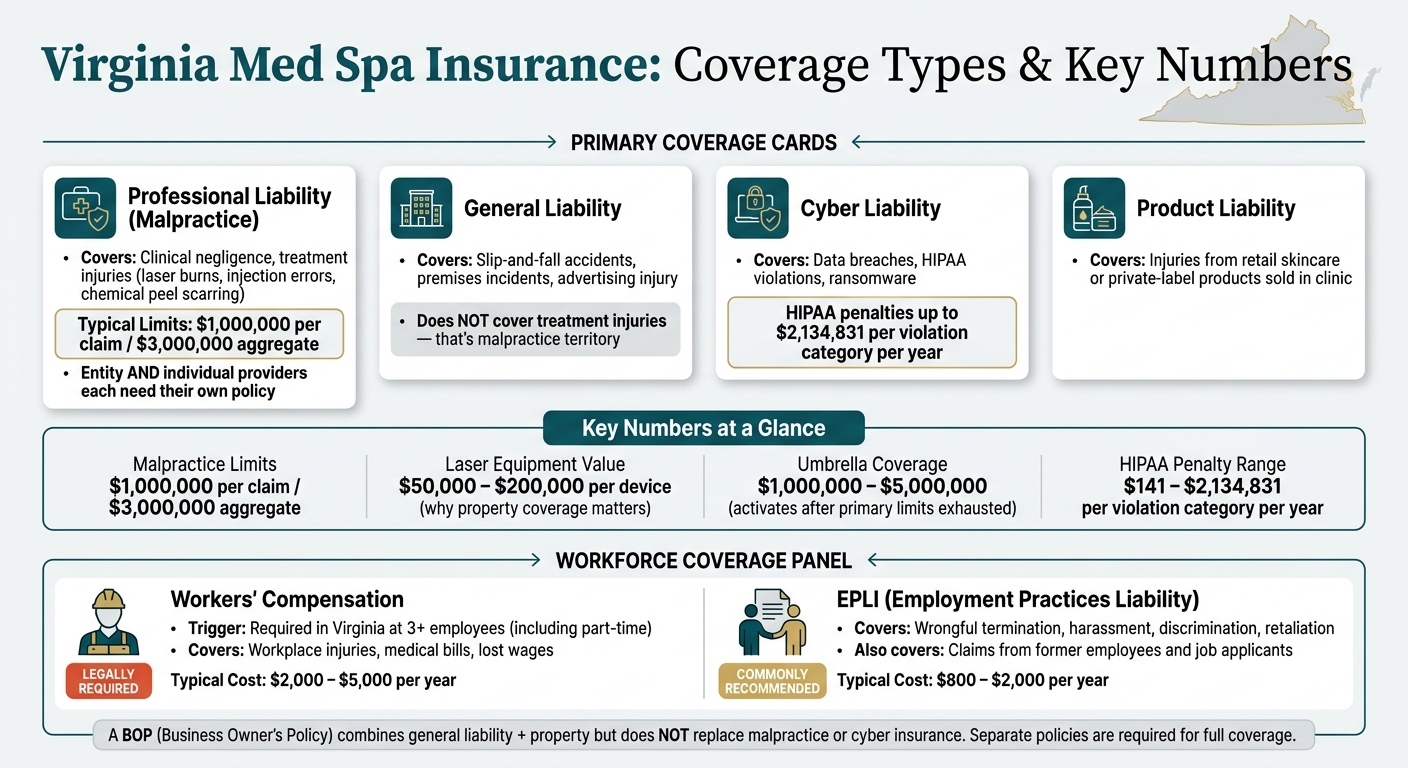
Virginia Med Spa Insurance Requirements: Coverage Types & Key Numbers
Virginia med spas usually need separate policies for clinical care, on-site incidents, digital exposure, and product claims. One all-in-one plan often leaves gaps.
After you define your scope, the next step is to stack coverage so each risk has a policy built for it.
Professional liability and general liability cover different risks
The rule is pretty simple: the type of claim decides which policy steps in. Malpractice handles treatment mistakes. General liability handles slip-and-fall cases and other premises claims.
| Coverage Type | What It Covers |
|---|---|
| Professional Liability | Clinical negligence and treatment injuries |
| General Liability | Premises accidents and advertising injury |
| Cyber Liability | Data breaches, HIPAA violations, ransomware |
| Product Liability | Injuries from retail skincare or topical products sold |
Entity coverage, provider coverage, and limits for higher-risk services
A medical director's policy does not cover the clinic itself. The business entity needs its own professional liability policy, separate from the coverage carried by any doctor, NP, PA, or nurse. If a claim names the clinic directly and the entity has no policy, the clinic is left exposed.
Clinicians who perform medical procedures should carry their own coverage too. If you use independent contractors, require malpractice insurance as a contract term and keep proof on file. That's one of those small admin tasks that can save a huge headache later.
Typical malpractice limits for med spas are $1,000,000 per claim and $3,000,000 aggregate. If the clinic offers lasers, deep chemical peels, GLP-1 weight loss, or hormone therapy, higher limits or service-specific endorsements may be needed. Add new services to the policy before launch, not after a claim shows up.
Property, cyber, product, and umbrella coverage
Liability coverage is only part of the picture. Med spas also need protection for equipment, patient data, retail products, and claims that blow past base limits.
Commercial property insurance matters more than many owners expect. In aesthetics, equipment is a major investment. A single laser machine can cost between $50,000 and $200,000.
Cyber liability is a must for any clinic that stores patient charts or payment data in digital systems. HIPAA penalties for data breaches can range from $141 to $2,134,831 per violation category per year. If the clinic sells retail skincare, especially private-label products, confirm that product liability is included. And if a claim gets large fast, umbrella coverage of $1,000,000 to $5,000,000 can add another layer once primary policy limits are used up.
A BOP can combine general liability and property coverage into one package, which is handy, but it does not replace malpractice or cyber insurance. Those need to be added on their own or bought as separate policies.
Workforce risk comes next, especially when Virginia staffing rules trigger workers' compensation.
Virginia workers' compensation and employment-related risks
After clinical coverage, the next piece is your team.
When the three-employee threshold triggers workers' compensation
In Virginia, workers' compensation usually kicks in when a business has three or more employees, including part-time staff. For med spas, that matters fast. Many clinics run with a mixed team, and each role comes with its own job-related risk.
Clinical staff may deal with needlestick injuries and chemical exposure. Front-desk staff are more likely to run into slips, falls, or repetitive strain from desk work. Workers' compensation helps cover medical bills and lost wages after an on-the-job injury. It also helps shield the owner from personal liability. In most cases, it costs about $2,000 to $5,000 per year, based on payroll and staff classifications.
One thing is worth checking early: staff classification. Most nurse injectors and estheticians should be treated as W-2 employees because the clinic controls their schedules, protocols, and equipment. If you get that wrong, you can end up with compliance gaps and a nasty surprise when someone files a claim.
EPLI and workforce documentation for multi-role teams
Workforce risk isn't just about physical injuries. Employment claims can hit hard too. Wrongful termination, harassment, discrimination, and retaliation can all lead to major legal costs. Even one claim can cost tens of thousands of dollars to defend or settle.
Employment Practices Liability Insurance (EPLI) usually costs between $800 and $2,000 per year. Once a clinic reaches the three-employee mark, it's often smart to look at it. EPLI may also respond to claims from former employees or even job applicants, including claims tied to discriminatory hiring practices.
| Coverage Type | Requirement Status | Operational Risk Addressed |
|---|---|---|
| Workers' Compensation | Required under Virginia law at 3+ employees | Workplace injuries, medical expenses, and lost wages |
| EPLI | Commonly Recommended | Wrongful termination, harassment, discrimination, and retaliation claims |
Use one system to track onboarding, job descriptions, performance reviews, and role changes. Clean workforce records can make a big difference when you need to defend a claim or show compliance.
Matching insurance to ownership structure, service mix, and daily operations
Insurance should fit how your clinic is set up, who provides care, what equipment you use, and which services you offer.
Coverage planning by clinic type and treatment menu
Insurers underwrite each clinic model in its own way. This table shows common Virginia clinic setups and the coverage priorities that usually come with them.
| Clinic Archetype | Core Coverages | Higher-Priority Coverage and Limits | Key Documentation Controls |
|---|---|---|---|
| Physician-owned med spa (lasers + injectables) | Professional liability, general liability, commercial property | Malpractice limits ($1M per claim/$3M aggregate); property coverage for laser equipment | Signed consent forms, treatment records |
| Injectables-focused practice (NP/PA-led, medical director oversight) | Professional liability with negligent supervision, general liability | Entity-level and individual provider coverage; negligent supervision coverage | Delegation protocols, Good Faith Exam records |
| Hybrid spa/medical model (esthetics + medical services) | Professional liability, general liability, cyber liability, product liability | Umbrella coverage as revenue grows; product liability if selling skincare lines | Service classification records (medical vs. non-medical), staff credential files |
When you add a new treatment or bring in a new device, tell your broker right away. That update should line up with the supervision terms in your policy.
Coverage is at its strongest when your records reflect the services you actually provide.
Operational systems that reduce claim risk
Keep consent forms, good-faith exam records, and delegation protocols current and stored in one place. If a claim comes up, scattered records can turn a bad day into a much more costly one.
Cyber risk is another spot where clinics can get caught off guard, especially if they store patient charts or payment data. HIPAA penalties for data breaches can range from $141 to $2,134,831 per violation category per year. Using HIPAA-compliant software for scheduling, intake, and communication is a practical way to lower that risk. Prospyr supports these controls with HIPAA-compliant scheduling, digital intake, AI notes, and patient communication.
You should also update your service list at renewal and any time you add a new treatment or device. Carriers rate professional liability based on disclosed services, so an old list can create a coverage gap.
Conclusion: A Virginia med spa insurance checklist for lower-risk growth
Before your next renewal, work through these checkpoints.
The smallest paperwork gaps often become the most expensive claim issues.
- Entity structure: Match coverage to ownership and require individual malpractice coverage for every treating provider.
- Service menu: Confirm every current treatment appears on the malpractice policy.
- Staff classification: Confirm W-2 versus contractor status and keep proof of coverage on file.
- Workers' compensation: If you have three or more employees, Virginia law requires it.
- EPLI: Add EPLI for termination, harassment, and discrimination claims.
- Documentation habits: Keep consent forms, supervision records, and incident logs current and easy to pull.
Insurance gaps in Virginia med spas usually stay hidden until a claim or audit brings them to the surface. Reviewing your coverage before that happens is the lower-cost move, by a wide margin.
FAQs
Do independent contractors need their own malpractice insurance?
Yes. Independent contractors should carry their own malpractice insurance.
Your entity-level policy may not cover contractors by default. And that can leave a gap in coverage.
The safer move is simple:
- Require each contractor to maintain their own policy
- Ask for a current Certificate of Insurance (COI) that lists your professional entity as the certificate holder
- Confirm that their policy covers the procedures they perform
It’s also smart to review both your policy terms and your contractor agreements with your broker. A small detail in the wording can make a big difference when a claim shows up.
When should I update my med spa insurance policy?
Review your med spa insurance policy every year, ideally before renewal, so you can catch coverage gaps before they turn into a problem.
You should also update your policy as soon as anything changes. That includes adding new services, buying new devices, hiring staff, or bringing on new independent contractors. If your carrier isn’t told about those changes, a claim could be denied. That’s a risk you don’t want to take.
Prospyr can help keep everything in one place, track renewal dates, and organize your insurance documents.
Which treatments usually require higher coverage limits?
Higher-risk, more invasive treatments usually call for higher coverage limits.
That often includes services like laser treatments, injectables such as Botox and fillers, IV therapy, fat-dissolving injections, thread lifts, CO2 lasers, ketamine therapy, and stem cell treatments.
If your practice offers any of these, or stores large amounts of sensitive patient health information, the standard $1 million per occurrence or $3 million aggregate may not be enough. In those cases, excess liability coverage can add another layer of protection.