Know the boundaries
Not for: Permanent fillers, biostimulatory fillers, silicone, body contouring, or a promise that filler is fully reversible.
Source-checked template, version 2.0, September 21, 2026. Practice review and adaptation are required before use. No independent clinician or attorney approval is claimed. Adult patient self-consent only; use a separately reviewed process for minors or representatives.
Inside the template
Two clean, unbranded patient-facing pages: the relevant discussion, specific choices and completion fields, and the patient decision with signatures. The PDF includes fillable fields and selection controls where applicable. Use the Word version to adapt the language. Sources and practice guidance stay on this page. Typed fields are not a verified electronic-signature service.
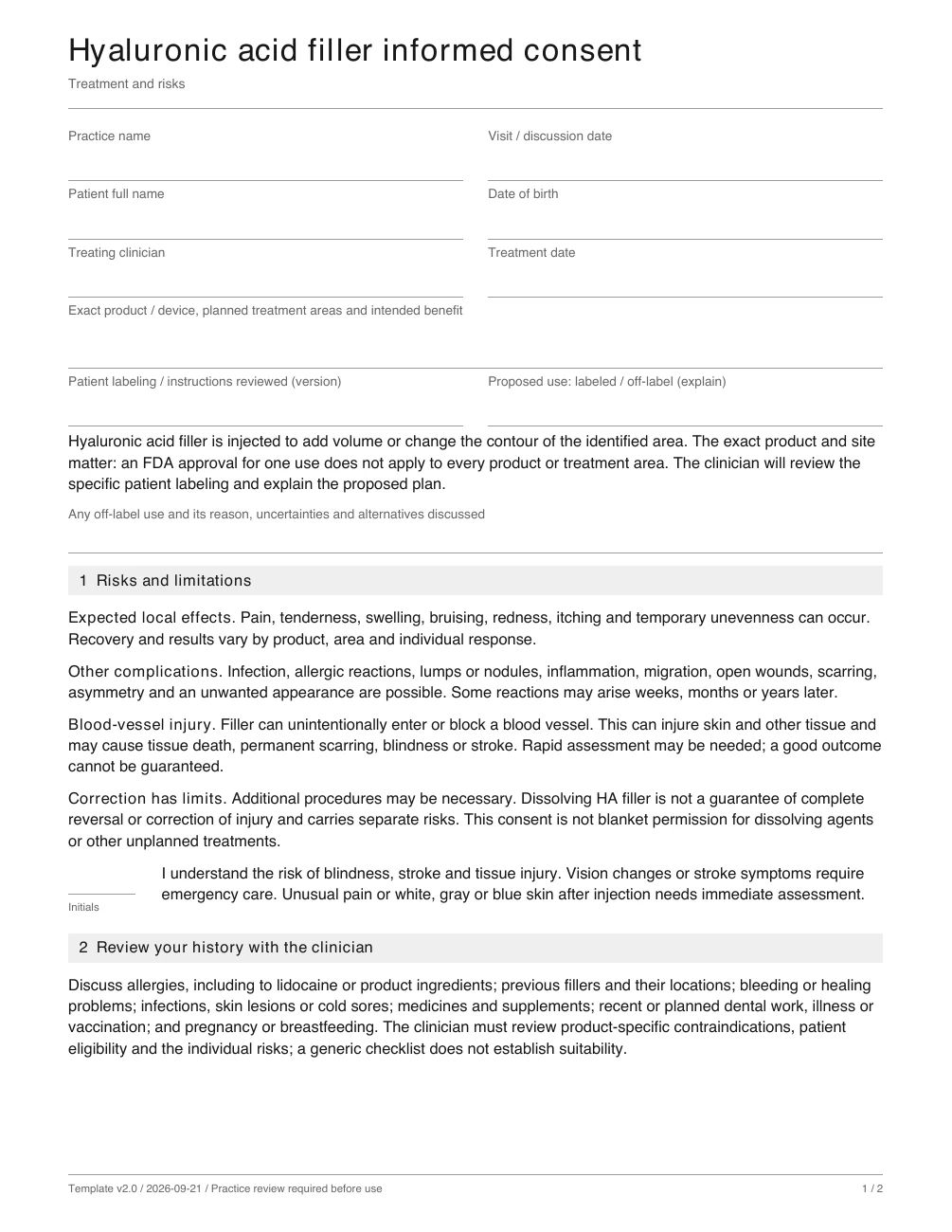
Actual sample page · Open to enlarge · Full editable files available below
Prepare your practice version
- Attach the patient labeling for the exact product and check the planned anatomical site.
- Explain common effects and serious vascular complications.
- Record previous filler, allergies, medicines and individualized risks.
- Document the urgent assessment route and discuss the limits and risks of any corrective treatment.
Public text preview
Language for the conversation
Expected local effects
Pain, tenderness, swelling, bruising, redness, itching and temporary unevenness can occur. Recovery and results vary by product, area and individual response.
Other complications
Infection, allergic reactions, lumps or nodules, inflammation, migration, open wounds, scarring, asymmetry and an unwanted appearance are possible. Some reactions may arise weeks, months or years later.
Blood-vessel injury
Filler can unintentionally enter or block a blood vessel. This can injure skin and other tissue and may cause tissue death, permanent scarring, blindness or stroke. Rapid assessment may be needed; a good outcome cannot be guaranteed.
Details to complete before signing
- Practice name
- Visit / discussion date
- Patient full name
- Date of birth
- Treating clinician
- Treatment date
- Exact product / device, planned treatment areas and intended benefit
- Patient labeling / instructions reviewed (version)
- Proposed use: labeled / off-label (explain)
- Any off-label use and its reason, uncertainties and alternatives discussed
- Relevant history, medicines, allergies and patient-specific risks / plan
- Alternatives discussed and patient questions / answers
- Written aftercare / patient information supplied
- Follow-up plan
- Urgent practice contact
- After-hours contact / instructions
- Patient signature
- Date / time
- Clinician / practice representative name
- Signature / date
- Interpreter name / ID if used
- Language
- Copy of completed consent provided by
- Date / method
Common questions
Is this a consent for every dermal filler?
No. Its scope is hyaluronic acid fillers. The treating clinician must add the specific product labeling, site risks and patient factors. Other filler materials need a different review.
Does the form waive responsibility for complications?
No. It records a discussion and voluntary decision; it is not a liability waiver or guarantee of an outcome.