California Medical Spa Ownership Rules: 2026 Guide
Treat California med spas offering injectables or prescriptions as medical practices: physician PC control, MSO for ops; avoid fee‑splitting.

If your California med spa offers Botox, lasers, IV therapy, or prescription-based treatments, I’d treat it as a medical practice from day one. That means a plain LLC, a lay-owned spa setup, or a paper-only medical director deal can put the business at risk fast.
Here’s the short answer:
- California does not issue a separate med spa license
- Medical services must sit in a lawful clinical entity
- Physicians usually must own at least 51% of the medical professional corporation
- Lay owners and investors cannot own the clinical side
- An MSO can run the business side, but not medical decisions
- Some NPs may practice independently in 2026 under AB 890, but PC ownership is still not clear
- Fee-splitting, weak supervision, and bad delegation are common trouble spots
In plain English: if I were opening or buying a med spa in California in 2026, I’d check four things first - ownership, entity structure, clinical control, and pay model. If one of those is off, the rest of the setup can fall apart.
A few points stand out:
- A med spa is judged by what it does, not what it calls itself
- A standard LLC cannot practice medicine in California
- The PC should control patient care, records, clinical staff, and professional fees
- The MSO should stay on the non-clinical side, like marketing, payroll, scheduling, rent, and admin support
- A 104 NP may have an independent path under AB 890 after 4,600 hours and board certification steps, but that does not fully settle every ownership question
- Payments tied to referrals, injections, or collections can trigger fee-splitting concerns under B&P § 650, with penalties that may reach $50,000 per violation
Quick comparison
| Topic | Main rule in California |
|---|---|
| Clinical ownership | Usually a physician-owned PC |
| Physician ownership floor | 51% if ownership is shared |
| Lay investor ownership of clinical entity | Not allowed |
| Standard LLC providing medical services | Not allowed |
| MSO role | Non-clinical business support only |
| Independent NP path | Limited path for qualifying 104 NPs |
| Common risk areas | Fee-splitting, sham supervision, bad delegation |
So before I launch, expand, or bring in investors, I’d make sure the legal structure matches how the med spa works every day - not just on paper.
sbb-itb-02f5876
California CPOM Rules and Who May Own a Med Spa
California CPOM rules decide who can own and run the medical side of a med spa.
How California defines the practice of medicine in a med spa
In California, services like Botox, fillers, laser hair removal, IV therapy, and prescription weight-loss protocols count as medical services. Why? Because they involve patient exams, treatment, prescriptions, or the use of regulated devices. Once a service falls into that bucket, ownership and control have to follow CPOM rules.
Who can legally own the clinical entity
So the clinical entity has to be owned and controlled by licensed professionals, not the consumer-facing spa brand or an investor group.
The usual setup is a physician-owned professional corporation, or PC. California-licensed MDs and DOs must own at least 51% of the PC. A standard LLC or general corporation can't own the medical practice. Lay ownership and lay control aren't allowed.
Independent NP ownership in 2026
California has one main exception: the qualifying 104 NP path. Under AB 890 and BPC § 2837.104, NPs who complete 4,600 hours of full-time practice as a 103 NP, get national certification in their population focus, and receive 104 NP certification can practice independently. The BRN may start certifying 104 NPs in 2026.
A qualifying 104 NP may open and operate within NP scope. But ownership of a medical PC is still unsettled. The cleaner route for a 104 NP is a nursing corporation that covers services within NP scope. Standard NPs who don't meet the 104 rules can't independently own the clinical entity.
Ownership eligibility table
Use this table to separate who may own from who may take part only on the operations side.
| Entity / Role | Can own clinical entity? | Maximum equity | Key conditions |
|---|---|---|---|
| MD / DO | Yes | 100% (min. 51% if shared) | Must be CA-licensed; standard ownership model |
| Qualifying 104 NP | Yes (limited) | 100% through a nursing corporation | Must meet AB 890 independent practice requirements; medical PC ownership remains unsettled |
| Standard NP / PA | No majority ownership | Minority ownership only, if allowed | Must be licensed; cannot hold majority control |
| Lay investor / private equity | No | 0% | Prohibited from clinical ownership; MSO structure required |
Reading about the problem? See how Prospyr solves it in one platform.
Book a DemoRequired Business Structure: PC, MSO, and Clinical Control
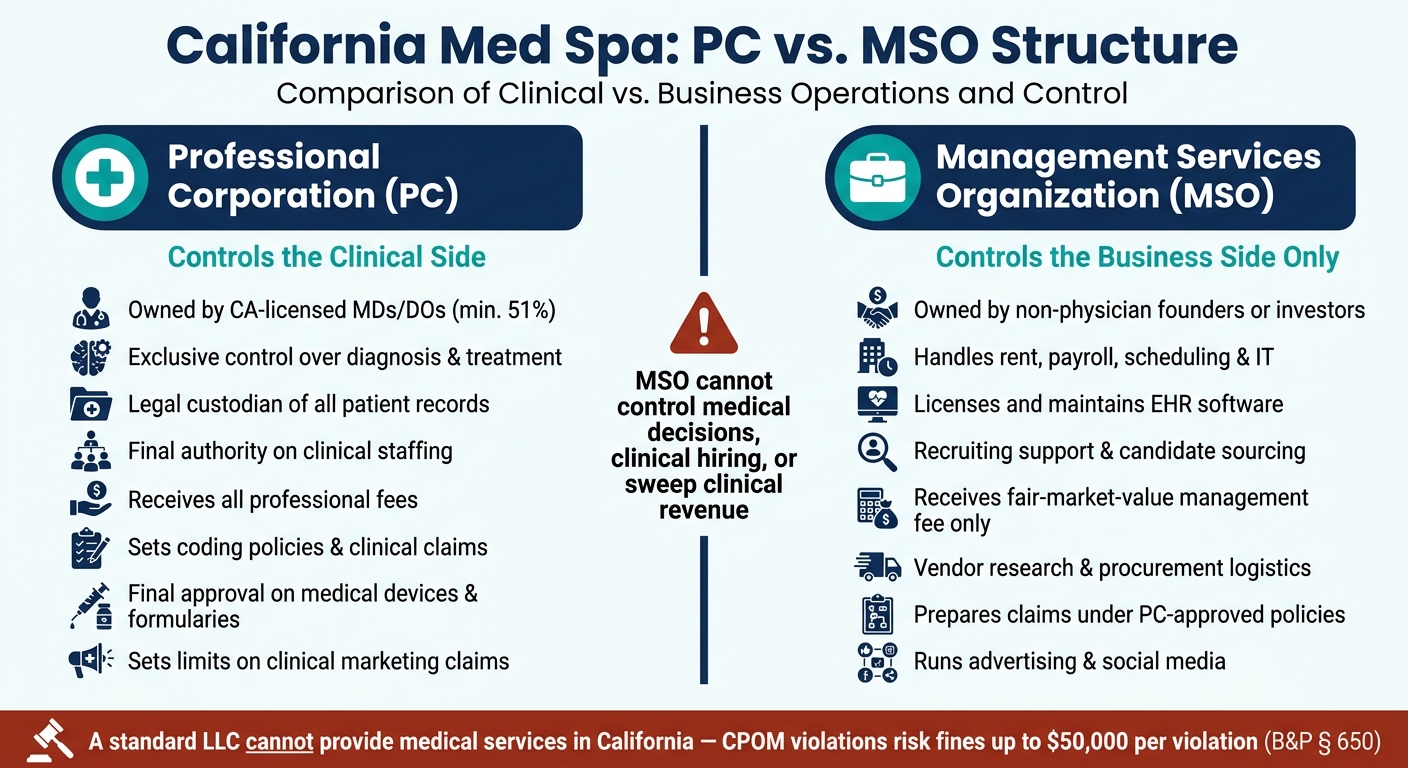
California Med Spa Ownership Structure: PC vs. MSO at a Glance
Why a standard LLC cannot provide medical services
In California, a standard LLC can't provide medical services. The state treats LLCs much like general corporations here: neither can practice medicine, directly or indirectly.
This is where many clinics get into trouble. A founder sets up an LLC for a wellness or aesthetics brand, starts offering injectables or laser treatments, and never forms a separate physician-owned PC. On paper, it may look like a normal startup move. In practice, regulators can see it as an unlawful lay-owned medical practice.
That can lead to problems on several fronts, including:
- Enforcement risk
- Malpractice coverage gaps
- Contract issues
What the professional corporation must control
The PC is the medical entity. It must be formed as a California professional medical corporation under Corporations Code §13400 et seq. Its Articles of Incorporation must state that its purpose is to engage in the profession of medicine, and California-licensed physicians must own at least 51% of the shares.
Day to day, the PC must control the clinical side of the practice. That includes clinical staff, treatment decisions, patient records, and professional fees. If non-physician owners of a med spa are hiring providers, setting treatment menus, or steering clinical decisions through another entity, that's a sign the PC does not have real control.
One point founders often miss is the name issue. If the PC uses a brand name instead of the physician's legal name, it must get a Fictitious Name Permit (FNP) from the Medical Board under Business and Professions Code §§2285 and 2415 before it advertises or practices under that name. Skipping the FNP can be treated as unprofessional conduct, even if the rest of the PC/MSO setup is in place. Branding also can't muddy the line on who controls the medical practice.
What the MSO can and cannot do
The MSO handles the business side of the operation. That usually includes rent, equipment procurement, administrative staffing, scheduling, marketing, billing support, payroll processing, and IT infrastructure. Those are proper non-clinical functions tied to running the business side of the clinic.
But the MSO has to stay in its lane. It cannot make diagnoses, set treatment plans, write clinical protocols, control prescribing decisions, or dictate staffing ratios for care delivery. It also cannot hire or fire licensed clinicians based on clinical performance in a way that gives it control over the practice of medicine.
PC vs. MSO structure table
| Function | Professional Corporation (PC) | Management Services Organization (MSO) |
|---|---|---|
| Ownership | California-licensed physicians; physician-controlled | Non-physician founders or investors |
| Clinical judgment | Exclusive control over diagnosis, treatment, and prescribing | No interference permitted |
| Patient records | Legal owner and custodian of all medical record content | Licenses and maintains EHR software |
| Clinical staffing | Final authority on hiring/firing based on clinical competency | Recruiting support, payroll admin, and candidate sourcing |
| Revenue role | Receives all professional fees for medical services | Receives a fair market value management fee for admin services |
| Equipment | Final approval of medical devices, formularies, and clinical supplies | Vendor research, procurement logistics, and pricing negotiations |
| Billing/coding | Sets coding policies and signs off on all claims | Prepares and submits claims under PC-approved policies |
| Marketing | Sets limits on clinical claims and professional messaging | Runs advertising, social media, and reputation management |
The PC and MSO need to stay separate in ownership, control, and cash flow. That split decides who can direct care on a daily basis, which the next section addresses.
Physician, NP, PA, and Staff Roles in Daily Operations
Once the PC/MSO structure is in place, California still draws a hard line around who can assess patients and who can do what in treatment. Put simply: the business setup alone doesn't control the medical side. A licensed clinician has to actually direct care day to day. If people start working outside their legal scope, even a valid PC/MSO model can run into trouble.
Physician or qualifying NP responsibility for patient care
The physician or qualifying 104 NP must personally lead patient care. That means doing the good-faith exam, approving the treatment plan, ordering or prescribing when needed, reviewing charts, and staying available for clinical questions.
A medical director who exists only on paper is a major risk. That kind of setup can look like aiding unlicensed practice.
What RNs, NPs, PAs, MAs, and estheticians may and may not do
RNs may perform delegated injectables and laser services, but only after the required exam and under the proper order or standardized procedures. They can't diagnose the patient or build the treatment plan.
Standard NPs and PAs may assess patients, prescribe within scope, and provide aesthetic treatments under the practice agreements or standardized procedures tied to their role. California supervision rules may also come into play.
Medical assistants and estheticians cannot perform medical procedures. Unlicensed persons may not inject Botox, and estheticians are limited to epidermal-level services like facials, superficial exfoliation, and waxing.
These role limits also affect compensation and management fees, which the next section covers.
Clinical role and supervision table
| Role | Can perform injectables? | Can conduct good-faith exam? | Needs standardized procedures or practice agreement? | Required supervision or authority |
|---|---|---|---|---|
| Physician (MD/DO) | Yes | Yes | No | Independent authority |
| Qualifying "104 NP" (AB 890) | Yes | Yes | No | Independent authority if statutory requirements are met |
| Standard NP | Yes, within scope | Yes | Yes | Standardized procedures and/or practice agreement with a physician |
| PA | Yes, within delegation | Yes | Yes | Written supervising-physician agreement and delegation of services |
| RN | Yes, when properly delegated | No | Yes | Physician, NP, or PA order plus supervision |
| Medical Assistant (MA) | No | No | N/A | Administrative and basic technical support only |
| Esthetician | No | No | N/A | Epidermal-level services only; no medical procedures |
Fee-Splitting Risks, Common Setup Mistakes, and Key Takeaways
A California med spa can have a proper PC-MSO setup on paper and still run into trouble fast. Once ownership is handled, the next pressure points are compensation and supervision. That’s where many CPOM issues start.
Fee-Splitting and Management Fee Red Flags
B&P § 650 bars value transfers that induce referrals or share professional fees. In the med spa world, that puts several common pay setups under a microscope.
| Payment Model | Risk Level | Compliance Notes |
|---|---|---|
| Per-treatment or per-injection commissions to RNs, NPs, or PAs | High | Ties pay to patient volume and can look like fee-splitting. |
| Referral bonuses to influencers or affiliates based on booked treatments or revenue | High | Looks like consideration paid as an inducement for referrals. |
| Medical director pay tied to collections | High | Can look like profit-sharing on clinical revenue instead of payment for defined services. |
| MSO management fee tied to PC gross revenue | Medium | Works only if it reflects fair-market value for nonclinical services or fair rental value, with written support. |
| Flat or tiered MSO fees tied to specific operational services | Lower | Cleaner when the fee is decoupled from patient volume and tied to nonclinical work. |
This isn’t a minor paperwork issue. Violations can bring fines of up to $50,000 per violation, criminal penalties, and license discipline.
Common California Med Spa Setup Mistakes
Most compliance problems begin with formation mistakes, then snowball. A standard LLC used for clinical services still creates CPOM risk.
Another common error is giving lay founders or non-licensed investors direct equity in the PC. In most cases, non-physicians cannot own shares in the clinical entity. If they do, the result can be CPOM risk, contract problems, and board scrutiny.
Then there’s the paper medical director problem. That’s the physician who signs forms and lends a name to the business but does not actually supervise care, review complications, or make sure standardized procedures are being followed. Regulators may treat that as a sham setup, and both the physician and the entity can face liability.
On the ground, the weak spots often look like this:
- Missing or poorly used standardized procedures for delegated treatments
- Unlicensed staff performing injections, laser work, or other delegated procedures without authority
- MSO agreements that give the management company control over clinical hiring, treatment menus, or revenue flow.
A 2026 Review Checklist Before Launch or Restructure
Use this review to test whether the setup works in day-to-day practice, not just in formation documents:
- Entity and ownership: Is the clinical entity a compliant professional corporation with all equity holders properly licensed under California law?
- Supervision model: Is there a clearly designated physician or qualifying 104 NP with real, documented clinical responsibility, not just a title?
- Scope of practice: Do NPs, PAs, RNs, MAs, and estheticians each have defined duties that match California scope-of-practice rules?
- Standardized procedures: Are current, signed protocols in place for delegated treatments, standing orders, emergency response, and chart review?
- Payment structure: Have all compensation arrangements - commissions, bonuses, medical director fees, and MSO payments - been reviewed against B&P § 650, with fair-market-value analyses where needed?
- Branding and permits: Does the consumer-facing brand match the licensed entity providing care, with all needed fictitious business name registrations in place?
- MSO agreement terms: Does the management agreement keep the MSO limited to nonclinical functions, with no right to control medical decisions or sweep clinical revenue?
This review should happen every year, when opening new locations, or before bringing in outside investors.
Conclusion: Getting California Ownership Rules Right in 2026
These are the points where a lawful structure most often slips into a compliance problem. The biggest breakdowns tend to be compensation, supervision, and documentation. The clinical entity has to remain under lawful physician control, or under a compliant qualifying 104 NP model, and that control has to be real rather than cosmetic. MSOs must stay in the nonclinical lane.
Ownership stays compliant only when payment terms, supervision, and documentation line up with the legal structure. Written systems help close those gaps. A HIPAA-compliant practice management platform like Prospyr can help organize scheduling, intake, charting support, and task workflows. For med spa owners in 2026, getting the ownership structure right at the start - and keeping it current as California law changes - is the step that matters most.
FAQs
Can a non-doctor own part of a California med spa?
Not directly. Under California’s CPOM rules, non-physicians can’t own a medical practice outright.
They can still take part in a couple of indirect ways.
- They may own part of a PC, as long as a physician keeps at least 51% ownership
- They may own an MSO that handles non-clinical functions
Starting in 2026, some nurse practitioners may also be allowed to own or co-own a med spa.
When does a med spa need a PC and an MSO?
In California, a med spa usually needs a physician-owned Professional Medical Corporation (PC) for the clinical side. That’s because clinical services must be delivered through a PC, not through a company owned by a non-physician.
If a non-physician wants to handle the business side, the usual setup is an MSO. The MSO can manage things like marketing, payroll, and scheduling.
But there’s a clear line it can’t cross. The MSO cannot control:
- Clinical decisions
- Medical record content
- Clinical hiring or firing
- Billing and coding choices that require clinical judgment
That split matters. The PC handles patient care. The MSO handles business operations.
What payment models create fee-splitting risk?
In California, compensation and management fees should match fair market value. They shouldn’t function as hidden profit-sharing or referral kickbacks.
That’s why percentage-of-net-profit deals are risky. In many cases, regulators may view them as illegal fee-splitting.
Safer options are usually:
- Fixed monthly fees
- Cost-plus models, where expenses are reimbursed with a reasonable margin
Medical director pay also needs a clean structure. Don’t tie it to procedure volume or to any specific patient referrals.
Related Blog Posts
Free PDF guide + worksheets
Build your California opening file.
Get the state highlights, linked official sources, service-by-service licensing worksheet, ownership questions and opening checklist in one printable guide.
- ✓ State-specific decisions and next steps
- ✓ Credential and supervision worksheet
- ✓ A place to track approvals, owners and renewals