New York Model Policy and Training: Checklist
Five-step annual checklist for NY sexual harassment compliance: policy, reporting, interactive training, records, and notices.
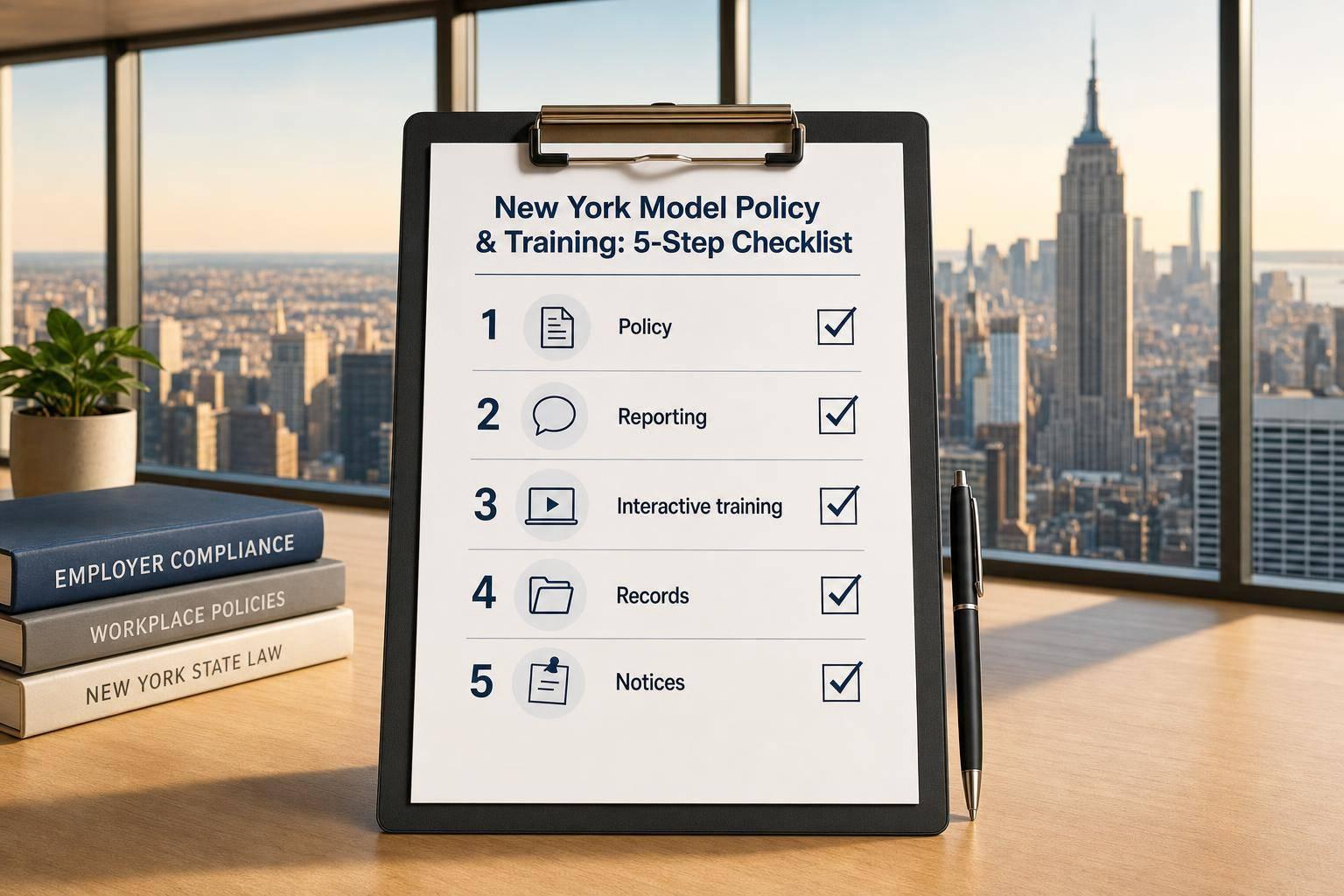

If you have employees in New York, you need 5 things in place: a written sexual harassment policy, clear reporting paths, annual interactive training, proof of completion, and employee notice records.
I’d treat this as a yearly file check, not just a training task. The article walks through what to confirm in each area, including the April 2023 model policy update, supervisor reporting rules, outside agency contacts, new-hire notice steps, language access, and NYC rules like 3-year recordkeeping for some employers.
Here’s the short version:
- Policy: Make sure it matches current New York rules and includes complaint forms, investigation steps, anti-retaliation language, and supervisor duties.
- Reporting: Give employees at least 2 internal reporting options, plus state, city, and federal agency contacts.
- Training: Train every employee each year with an interactive format, not just a video or handout.
- Records: Keep attendance logs, acknowledgments, certificates, material versions, and make-up training records.
- Notices: Give the policy and related documents at hire and during the annual training cycle.
- NYC add-ons: Watch for bystander intervention content, posting rules, factsheet delivery, and record retention where city rules apply.
A simple way to read the piece: check the policy first, then reporting, then training, then records, then final leader review. That order helps you catch gaps before the next annual cycle.
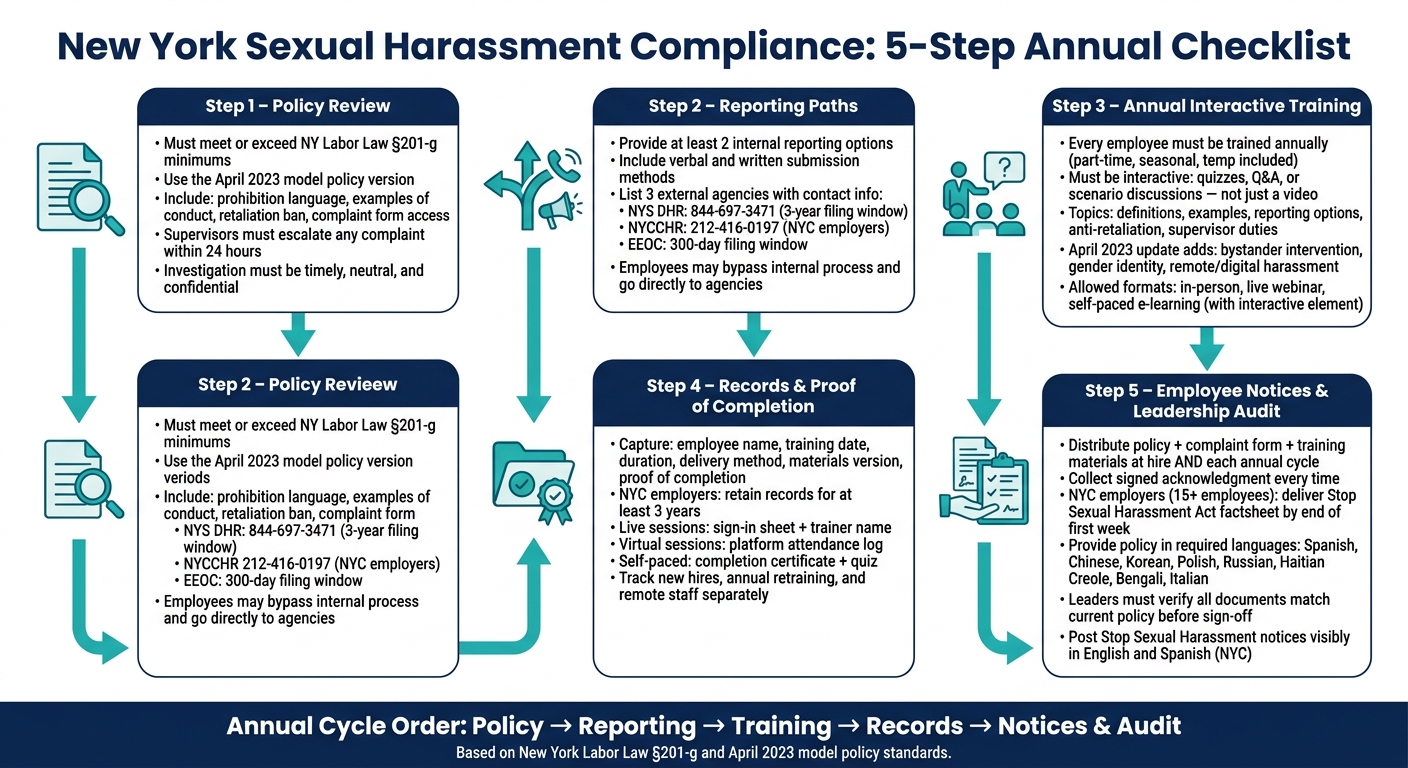
New York Sexual Harassment Compliance: 5-Step Annual Checklist
1. Policy Review and Adoption Checklist
Under New York Labor Law §201-g, you need to adopt either the state model policy or a custom policy that meets or goes beyond the minimum standards. Before anyone signs off, use the April 2023 version of the model policy.
Required Policy Content
Every compliant policy should cover the items below.
| Policy Element | What to Confirm |
|---|---|
| Prohibition language | Policy states that sexual harassment is prohibited and is employee misconduct subject to discipline. |
| Examples of prohibited conduct | Policy includes examples of verbal, physical, visual, and digital harassment. |
| Federal and NY law references | Policy references Title VII and the New York State Human Rights Law and explains available remedies and reporting forums. |
| Retaliation prohibition | Policy defines retaliation, states that it is unlawful, and gives examples such as schedule cuts or exclusion from training. |
| Employee rights and remedies | Policy explains internal and external reporting options, including internal reporting and external filing rights. |
| Complaint form access | Policy includes or references a standardized complaint form, available in paper and digital intake formats. |
If the complaint form lives somewhere else, like an internal portal, the policy should tell employees exactly where to find it.
The policy also needs to spell out how complaints are investigated. This shouldn't be left vague or buried in general language.
Investigation and Due Process Procedures
The policy must describe a timely, confidential investigation process. Put the steps in writing so employees and managers aren't left guessing. At a minimum, confirm that it says:
- Investigation starts immediately under a written deadline.
- A neutral investigator handles the matter and has no direct interest in the outcome.
- The complainant and respondent are both interviewed and given a chance to respond to the allegations.
- Interview notes, evidence, and the final report are stored in a restricted-access file.
- Retaliation during or after the investigation is treated as separate misconduct and investigated on its own.
That last point matters more than many teams expect. If someone reports harassment and then gets iced out of training or has shifts cut, that can trigger a second issue, not just an add-on to the first complaint.
Supervisor Responsibilities
Supervisors must escalate any complaint or observation of potential harassment to HR or practice leadership within 24 hours. That rule applies even when the report is verbal and the employee says they don't want to "make it a big deal."
Here’s what to verify:
- Escalation is required within 24 hours of any report.
- Log all informal complaints as formal reports.
- Supervisors with a conflict of interest must recuse themselves and direct the report to an alternate channel.
- Supervisors who fail to report or act on harassment face discipline.
In plain English, supervisors don't get to sit on a complaint, downplay it, or wait to see if it blows over. Once they hear about possible harassment - or see conduct that points to it - the clock starts ticking.
sbb-itb-02f5876
2. Complaint Process and Reporting Paths Checklist
Once the policy covers investigations and supervisor escalation, it needs to lay out every reporting path an employee can use. After the policy is adopted, each route should be mapped in plain English so people know exactly where to go.
Internal Reporting Steps
The policy should include at least two internal reporting routes so one blocked path can't stop a complaint. In most clinics, the first route is the employee's direct supervisor or manager. But that can't be the only option. The policy should also name a separate backup contact, such as HR, the practice owner, a compliance lead, or another manager outside the employee's reporting line. That's especially important when the supervisor is the person named in the complaint.
The policy also needs to explain how an employee can report. Both verbal and written complaints should be allowed. And the clinic should list each method it uses, such as email, a paper form, an online form, or a confidential hotline, if one is available.
If someone reports verbally, the policy should say who writes it down and whether the employee is asked to sign a summary. That may sound like a small detail, but it's often where confusion starts.
Here are the main items to check:
| Checklist Item | What to Verify |
|---|---|
| Primary reporting contact | Named by job title, not just by name |
| Backup contact | Listed separately for cases where the supervisor is involved or unavailable |
| Submission methods | Policy states complaints may be made verbally, in writing, by email, through an online form, or through a confidential hotline if used |
| Verbal complaint documentation | Policy explains who documents verbal reports and whether the employee signs a summary |
| Reporting access | Posted in the handbook, onboarding materials, and break room notices, and available in the intranet or HR portal |
| Retaliation protection statement | Reporting is protected from retaliation |
A simple gut check helps here: a new hire should be able to explain the reporting options back to a manager after orientation. If they can't, the process isn't clear enough.
External Agencies and Contact Information
After the internal contacts, the policy should list the outside agencies employees may use. Both the internal and external paths need to be visible to all employees. And employees may go to an outside agency without finishing the internal process first.
Three agencies should appear by name, and their contact details should be checked before each annual review cycle:
- New York State Division of Human Rights (NYS DHR): File online, by phone at 844-NYS-DHR1 (844-697-3471), by mail, fax, or in person. Sexual harassment complaints must generally be filed within three years of the most recent incident.
- New York City Commission on Human Rights (NYCCHR): For NYC clinics. Reach the Commission at 212-416-0197 or online.
- U.S. Equal Employment Opportunity Commission (EEOC): Employees generally must file within 300 days of the most recent incident. The EEOC accepts filings online, by mail, in person at the New York District Office, or by phone interview.
The policy should also state that employees may use state or federal court after agency proceedings.
Reading about the problem? See how Prospyr solves it in one platform.
Book a Demo3. Training Materials and Delivery Checklist
Once your reporting paths are mapped, the next job is making sure the training itself can stand up to scrutiny. In New York, every employee must receive annual sexual harassment prevention training - no matter the business size, job title, or work schedule. That includes part-time, seasonal, and temporary staff.
Required Annual Training Topics
Your training should mirror the same reporting rules and anti-retaliation standards in your written policy. New York sets a baseline for what this training must cover. Make sure your materials include each of the topics below.
| Topic | What to Include |
|---|---|
| Definition of sexual harassment | Both quid pro quo and hostile work environment, consistent with NYSDOL and DHR guidance |
| Examples of unlawful conduct | Clinic-specific scenarios - e.g., comments about a coworker's appearance, unwanted touching during treatments, sexually suggestive jokes, or harassment via text messages or social media between staff |
| Federal and state statutory provisions | Title VII, New York State Human Rights Law, and NYC law if applicable |
| Reporting and filing options | Internal and external reporting options, including agency filing rights |
| Complaint rights | Employees may report harassment they witness; good-faith reports are protected |
| Anti-retaliation rules | Examples of retaliation (schedule cuts, negative reviews tied to a complaint, exclusion from meetings) |
| Supervisor responsibilities | Duty to report, obligation to escalate, and prohibition on minimizing complaints |
New York’s April 2023 update to its model training also puts extra focus on bystander intervention, gender identity and expression, and harassment in remote or digital settings, including chat platforms and telehealth tools. If your materials haven’t been updated since then, compare them against the current model resources before your next annual training cycle.
Interactive Delivery and Material Control
A passive video or a document employees read on their own is not enough to meet New York’s interactivity rule. Training needs some form of participation. That can be embedded quiz questions, a live Q&A, scenario-based discussion, or a way for employees to send questions and get answers within a reasonable time.
New York allows in-person sessions, live webinars, and self-paced e-learning modules, but the interactive piece must be there and it must be documented. If your clinic has both onsite and remote staff, the rule doesn’t change. Remote workers need the same level of training, delivered on a documented schedule, with digital access to all materials when the training is given.
Version control matters here. Put a version number and effective date on every slide deck, script, handout, and quiz. Then link each attendance record to the exact version that was used.
The next step is simple: line up each training version with the policy and notice packet employees receive.
Document Matrix: Policy vs. Training vs. Notice Packet
Use this matrix to check that your policy, training, and notice packet match. They do different jobs, but the core information needs to stay in sync.
| Item | Written Policy | Training Materials | Employee Notice Packet |
|---|---|---|---|
| Definition of sexual harassment | ✓ | ✓ | - |
| Complaint procedure (step-by-step) | ✓ | ✓ | ✓ |
| Internal reporting contacts | ✓ | ✓ | ✓ |
| External agency contact details | ✓ | ✓ | ✓ |
| Anti-retaliation statement | ✓ | ✓ | ✓ |
| Case studies and scenarios | - | ✓ | - |
| Quizzes and knowledge checks | - | ✓ | - |
| Signed acknowledgment form | - | - | ✓ |
| Complaint form | ✓ | - | ✓ |
| Version number and effective date | ✓ | ✓ | ✓ |
Keep the policy, training, and notice-packet versions aligned, and use the packet both at hire and during annual retraining.
4. Attendance Logs and Proof of Completion Checklist
Keep proof that every employee finished each training session.
Training Completion Records
Once the training content is set, the next job is simple: document who completed it. Keep a record you can pull up later for every live, virtual, or on-demand session. NYC employers must keep training records, including signed acknowledgments or certificates, for at least three years and provide them on request. New York State also encourages employers to keep signed acknowledgments and copies of training records.
Use the same core fields for every training record, no matter how the training was delivered.
| Field | What to Capture |
|---|---|
| Employee name and job title | Full legal name; consistent spelling across all records |
| Training date and duration | Date completed; total time in session |
| Delivery method | In-person, live webinar, or self-paced e-learning |
| Trainer name (or vendor) | Internal facilitator or external vendor |
| Site or access mode | Clinic site, remote, hybrid, or on-demand platform |
| Training materials version | Version number and effective date of slides, handouts, and policy used |
| Proof of completion | Certificate, signed and dated attendance sheet, or LMS export report |
| Policy acknowledgment | Signed form confirming receipt of the current policy version |
For session-level proof, keep different items based on the format.
- Live sessions: sign-in sheet, timestamp, trainer name, agenda or slide deck version
- Virtual sessions: platform attendance log, meeting date and time, participation record
- Self-paced modules: completion certificate, quiz score, access log, module version. If a platform issues only one certificate per user, keep a separate roster for group sessions.
After that, sort records by employee status so you can quickly confirm onboarding, annual retraining, and remote participation.
New Hires, Annual Retraining, and Remote Staff
For new hires, connect each record to onboarding, the policy receipt date, and the training completion date. The file should show the hire date, start date, policy distribution date, training completion date, and the name of the onboarding coordinator. If someone starts in the middle of the training cycle, the record should also show that they got both initial orientation training and the next scheduled annual refresher.
For annual retraining, track the deadline, the date training was assigned, reminder dates, escalation steps for late completion, and the final completion date. If an employee misses a live session, document whether they finished a make-up session, an on-demand module, or one-on-one remediation. Also note the reason for the delay and the supervisor who was notified. Keep records of reminders, escalations, and make-up training.
For remote and off-site staff, keep the completion certificate, platform attendance or access report, and signed acknowledgment. If the employee signed electronically, store that signed form with the training file.
Also keep proof of any qualifying training completed earlier in the calendar year for a prior employer.
A clean folder system makes this much easier, whether you use paper files or digital storage. Keep one record set for each training cycle, with subfolders for attendance logs, certificates, policy versions, notices, and sign-off forms. A practice administrator should be able to pull any employee's certificate, materials version, and signed acknowledgment within minutes.
Next, match these records to employee notices and leadership sign-off.
5. Employee Notices and Leadership Audit Checklist
Once your training records are in order, the last step is simple on paper but easy to miss in practice: make sure each employee got the right documents, and make sure leadership checked everything before sign-off.
Policy Distribution and Employee Receipt
New York State requires employers to give each employee the written sexual harassment prevention policy and notice packet both at hire and during each annual training cycle. That packet should include the policy, the complaint form, and the current training materials. You can send it on paper or electronically, as long as employees can access it and print a copy.
For new hires, send the packet at the start of employment, before or alongside onboarding training. During the annual cycle, send the packet again to all active employees when training is delivered, and collect a signed acknowledgment every time. Paper and electronic acknowledgments are both allowed. If your clinic is in NYC and has 15 or more employees, you also need to give every new hire the Stop Sexual Harassment Act factsheet no later than the end of the first week.
You also need to provide the policy and notice in any required employee language: Spanish, Chinese, Korean, Polish, Russian, Haitian Creole, Bengali, or Italian. New York State offers model templates for each one. Keep a record showing how you reviewed and met each employee's language needs.
Use the table below to check each required delivery point.
| Distribution Checkpoint | New Hire | Annual Cycle |
|---|---|---|
| Written policy provided | ✓ | ✓ |
| Complaint form included | ✓ | ✓ |
| Training materials included | ✓ | ✓ |
| Signed acknowledgment collected | ✓ | ✓ |
| NYC factsheet distributed (15+ employees) | ✓ | - |
| Language needs assessed and met | ✓ | ✓ |
| Policy posted in all work locations | ✓ | Verify annually |
Once distribution is documented, review those same materials side by side before sign-off. If one version has an old contact name or an outdated form, that's where problems start.
Practice Leader Audit Before Sign-Off
After distribution and acknowledgments are logged, leaders should check that every document lines up with the current policy and training files.
Start with the policy itself. Confirm the written policy matches current New York model standards. Then review complaint contacts and reporting paths. Every document and posting should show the same current contact details, plus an alternate contact. Also confirm that the agency names and contact details for the New York State Division of Human Rights, the EEOC, and, when it applies, the NYC Commission on Human Rights are up to date.
Next, check supervisor completion. All managers and supervisors must complete annual training, including the parts tied to their reporting duties and bystander intervention where required. If a supervisor was promoted in the middle of the cycle, confirm that person received the updated policy materials. If complaints came in during the year, review those files to make sure supervisors followed the policy and did not interfere with the investigation process.
For NYC-covered clinics, confirm that Stop Sexual Harassment notices are posted in a visible place in English and Spanish in common areas, or posted electronically for remote teams, and that the versions in use are current. Last, make sure the documentation is complete and easy to review.
Conclusion: Final Compliance Checks for the Next Annual Cycle
A clean annual cycle comes down to six connected pieces: a written policy that matches current New York standards, reporting paths that are accurate everywhere they appear, interactive training delivered to all covered staff, complete attendance and acknowledgment logs, timely employee notices at hire and annually, and a documented leadership audit before sign-off.
FAQs
Does this apply to part-time and remote staff?
Yes. Compliance policies and training rules apply to all staff no matter their employment status or where they work if their role involves Protected Health Information, patient safety, or clinical duties.
For nonexempt employees, mandatory policy reviews and training done remotely count as paid work time. Keep attendance logs, training records, and policy acknowledgments for every staff member.
What makes New York training interactive?
New York training works best when it’s interactive and tailored to the people doing the job. Generic, one-size-fits-all lessons usually miss the mark. A better approach is to use role-specific modules for injectors, front desk staff, and other team members.
The training should match what each person handles day to day. That includes tasks like managing PHI, following infection control rules, and sticking to safety steps in the clinic. It also helps to include hands-on skills checklists, quarterly emergency drills, and documented evaluations to confirm clinical competency and safety protocols.
What records should we keep each year?
Keep your annual documentation current and ready for review. That includes:
- staff credentialing files
- written delegation agreements and signed SOPs
- training logs and signed acknowledgments
- medical records and HIPAA documentation
For record retention, hold on to medical records and HIPAA documents for at least 6 years.
If you decide not to notify patients about minor privacy disclosures, keep your "no harm" determinations for 5 years.