Botulinum vs Filler Consent Requirements
Separate consents are needed: botulinum focuses on toxin spread and neurologic screening; filler focuses on vascular risk, traceability, and urgent reporting.


Botulinum toxin and dermal fillers should not share one consent form. I’d split them because the main risks, screening points, and charting needs are different.
Here’s the short answer:
- Botulinum consent should focus on toxin spread, muscle weakness, neurologic screening, medication review, pregnancy/breastfeeding statements, and brand/use details.
- Filler consent should focus on vascular occlusion, tissue necrosis, vision loss, stroke risk, delayed reactions, reversibility limits, urgent symptom reporting, and product traceability.
- Both forms should still cover the basics: elective treatment, no guarantee of results, common injection risks, alternatives, medical history, photo consent, and dated signatures.
- The FDA boxed warning matters for botulinum products.
- For fillers, the FDA has warned about blood vessel injection risk, and one cited estimate puts vascular occlusion at about 1 in 5,000 injections.
- Filler problems may appear weeks or months later, and urgent symptoms can show up up to 72 hours after treatment.
If I were setting this up in a clinic, I’d use one shared digital intake section and then split into two separate consent paths. That keeps the common items in one place while making sure each procedure has the right warnings and records.
| Topic | Botulinum Toxin | Dermal Filler |
|---|---|---|
| Main risk focus | Distant spread of toxin effect | Vascular blockage and delayed filler events |
| Key warning | Weakness, ptosis, swallowing or breathing problems | Vision loss, stroke, necrosis, nodules, granulomas |
| Screening focus | Neuromuscular disease, meds, pregnancy/breastfeeding | Product type, urgent red-flag symptoms, reversibility |
| Documentation focus | Brand, use, site-related weakness risks | Lot/batch, expiration, volume, site, plane, event tracking |
| Emergency language | Toxin side effects may appear hours to weeks later | Same-day reporting and ER direction if needed |
Bottom line: botulinum consent is about toxin effect, while filler consent is about vascular danger, product tracking, and aftercare escalation.
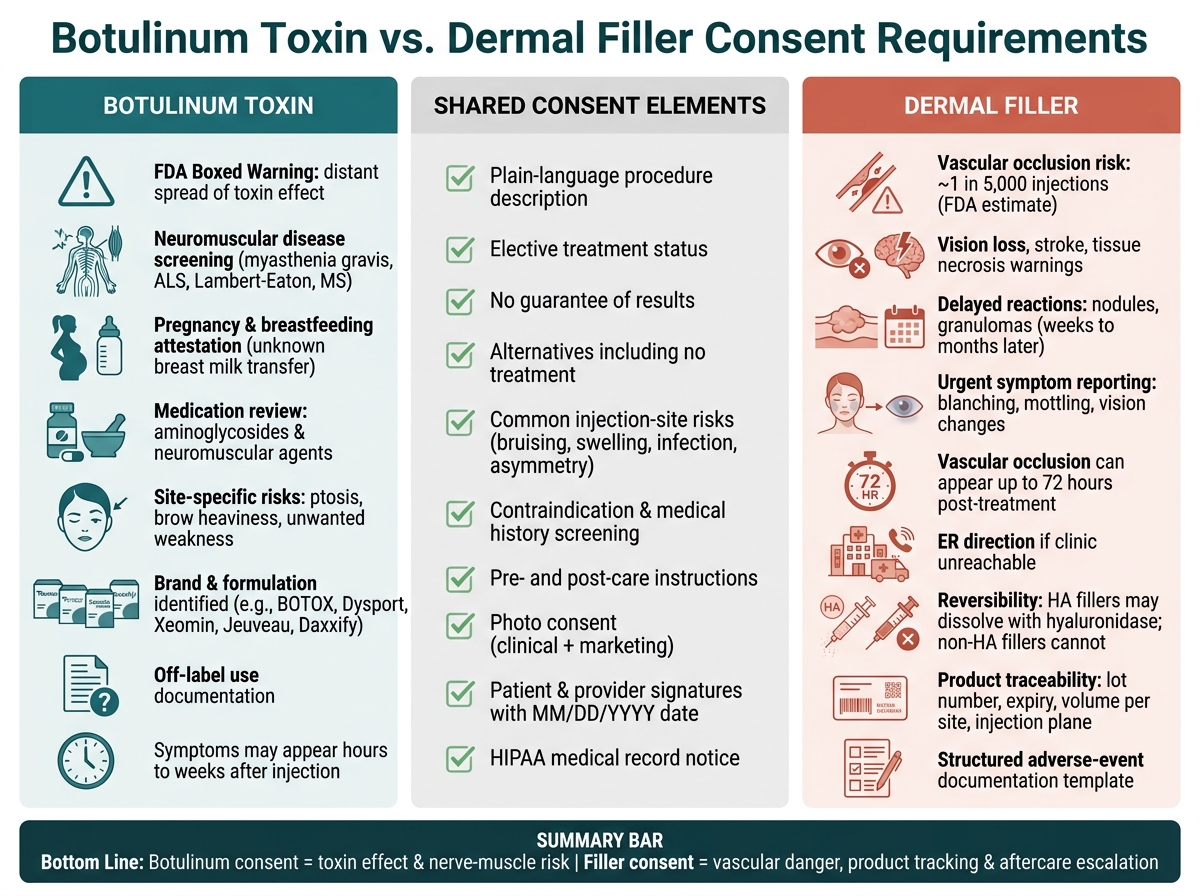
Botulinum Toxin vs Dermal Filler Consent Requirements: Key Differences
Consent Requirements Shared by Botulinum Toxin and Dermal Filler Forms
Botulinum toxin and dermal filler forms start from the same consent baseline, even though the risk details later go in different directions. In the U.S., informed consent means giving a patient enough information to make a voluntary, informed choice. That same standard applies to both treatments.
Baseline Fields Both Consent Forms Should Include
Both forms should explain, in plain language, what the treatment is meant to do. They should also state that the procedure is elective, that results can vary, and that the effects are temporary.
Both need contraindication screening as well. That includes pregnancy, breastfeeding, autoimmune or neurologic conditions, current medications, known allergies, and any past bad reaction to injectables.
Signatures matter on both forms. Each one should include patient and provider signatures, along with MM/DD/YYYY date fields. A witness signature should be added only when it's required. If the patient is under 18, a parent or legal guardian must sign.
Photo consent should appear on both forms too, with separate choices for:
- clinical record use
- marketing use
The form should also make clear that clinical photos are part of the HIPAA-protected medical record.
Just as important, both forms should show that the patient had a chance to ask questions and got answers before signing. After that shared starting point, the wording begins to change based on the risks tied to each procedure.
Comparison Table: Consent Elements Shared by Both Procedures
| Consent Element | Botulinum Toxin Form | Dermal Filler Form |
|---|---|---|
| Plain-language procedure description | ✓ | ✓ |
| Elective treatment status | ✓ | ✓ |
| No guarantee of results; outcomes vary | ✓ | ✓ |
| Alternatives, including no treatment | ✓ | ✓ |
| Shared injection-site risks (bruising, swelling, redness, pain or tenderness, infection, asymmetry, unsatisfactory cosmetic result) | ✓ | ✓ |
| Contraindication and medical history screening | ✓ | ✓ |
| Temporary results and maintenance treatment expectations | ✓ | ✓ |
| Pre- and post-care instructions | ✓ | ✓ |
| Photo consent | ✓ | ✓ |
| Patient and provider signatures with MM/DD/YYYY date fields | ✓ | ✓ |
| Medical record notice | ✓ | ✓ |
That’s the shared core. From there, the forms split into procedure-specific risks and documentation needs. The overlap stops where those risks part ways.
sbb-itb-02f5876
Reading about the problem? See how Prospyr solves it in one platform.
Book a DemoHow Botulinum Consent Differs from Filler Consent
Botulinum consent is different from filler consent for a simple reason: the main risk comes from nerve-to-muscle blocking, not from placing volume under the skin. So while the two forms share some basics, botulinum consent needs extra screening for neurologic issues and clear toxin-specific warnings.
Risk and Screening Language Specific to Botulinum Toxin
Start with the FDA Boxed Warning in its own section and have the patient initial it. The form should state that distant spread can cause weakness, ptosis, diplopia, dysphagia, dysarthria, and breathing problems hours to weeks after injection. It should also say plainly that swallowing and breathing difficulties can be life-threatening.
Include a checklist item where patients confirm they do not have myasthenia gravis, Lambert–Eaton syndrome, ALS, MS, or other motor neuropathies. This part matters because these conditions can change how the toxin affects the body.
The form should also include a direct pregnancy and breastfeeding attestation: the patient is not pregnant, not trying to conceive, and not breastfeeding. It should also say, right on the form, that it is unknown whether the toxin passes into breast milk.
Medication review needs its own clear line too. List drugs that can increase toxin effect, especially aminoglycosides and other neuromuscular agents.
Comparison Table: Consent Fields Specific to Botulinum Toxin
| Consent Field | Botulinum Toxin Form | Notes |
|---|---|---|
| Mechanism of action (nerve-to-muscle blocking) | ✓ | Explains temporary muscle weakening, not volumizing |
| Expected onset and duration | ✓ | Covers when effects begin and how long they last |
| Brand and formulation identified | ✓ | For example, BOTOX Cosmetic, Dysport, Xeomin, Jeuveau, Daxxify, or Letybo |
| Indication and off-label use documented | ✓ | Covers FDA-approved uses and off-label indications such as masseter slimming, lip flip, and gummy smile |
| FDA Boxed Warning (distant spread of toxin effects) | ✓ | Highlighted acknowledgment or initials; symptoms may appear hours to weeks after injection |
| Neuromuscular disease screening | ✓ | Myasthenia gravis, ALS, Lambert-Eaton syndrome, MS, and motor neuropathies |
| Pregnancy and breastfeeding attestation | ✓ | Direct attestation; note unknown breast milk transfer on the form |
| Medication review for neuromuscular agents | ✓ | Aminoglycosides and other agents affecting nerve-to-muscle signaling |
| Site-specific functional risks (ptosis, brow heaviness, unwanted weakness) | ✓ | Usually temporary, but may last for the full duration of toxin action |
Filler consent, by contrast, leans more on product identification, vascular risk, and documentation of how complications will be handled.
Why Filler Consent Requires More Risk Language, Product Details, and Event Documentation
Filler consent needs more detail because the risks are different. Some complications are severe. Some show up later. And some can't be reversed. Compared with botulinum consent, filler consent needs three extra layers: vascular emergency language, product traceability, and complication documentation.
Filler Risk Disclosures That Go Beyond the Botulinum Baseline
Add a Serious Risks section that spells out vascular occlusion, tissue necrosis, vision loss, stroke, nodules, granulomas, and delayed inflammatory reactions in plain language. Patients should also be told that some of these problems may appear weeks or months after treatment. The FDA reports that vascular occlusion happens in about 1 in 5,000 injections. That risk is rare, but it's far too serious to leave vague.
The consent should also include a section on urgent symptom recognition and same-day reporting. Tell patients to call the same day if they notice:
- sudden severe or worsening pain
- blanching or gray/dark discoloration
- mottling
- blisters
- any sudden change in vision
State clearly that vascular occlusion can appear up to 72 hours after treatment. If the office can't be reached, direct the patient to the emergency department.
You should also explain reversibility in plain terms. HA fillers may be partially reversible with hyaluronidase, while non-HA fillers are not. It also matters to note that no hyaluronidase product is currently FDA-approved specifically for dissolving filler. HA filler duration varies by product and treatment area, and results are not guaranteed to match before-and-after photos.
Because these problems can change after the visit is over, the consent form also needs to support fast, clear event documentation.
Product-Level Documentation Required for Filler Procedures
Filler charting needs more traceability than botulinum records usually do. Record the product name, manufacturer, lot or batch number, expiration date, total syringe volume, volume per site, injection plane, treatment date and time, and injector name. That level of detail helps connect delayed complications to a specific lot or batch. It also helps if there's ever a recall.
If a complication happens, document symptom onset, objective findings, photos, product details, management steps, referrals, and follow-up outcome. Prospyr can support this workflow with integrated EMR and digital intake forms.
Comparison Table: Filler Consent Additions vs. Botulinum Consent
The table below isolates the filler-only additions.
| Risk or Documentation Category | Botulinum Consent | Filler Consent |
|---|---|---|
| Vascular occlusion and tissue necrosis | - | Explicit warning about vessel blockage, skin color changes, blistering, tissue death, and possible scarring |
| Vision changes and blindness | - | Plain-language warning covering sudden vision loss, blind spots, severe eye pain, and possible irreversibility |
| Stroke and neurologic events | - | Disclosure that filler emboli can reach intracranial vessels in rare cases |
| Delayed inflammatory reactions, nodules, granulomas | - | Named explicitly; patients told these may appear weeks to months after treatment |
| Reversibility and hyaluronidase | - | Distinguishes HA vs. non-HA fillers; hyaluronidase is not FDA-approved specifically for filler dissolution |
| Urgent symptom reporting | General post-care instructions | Red-flag symptoms listed; same-day reporting required; after-hours pathway stated |
| Emergency management disclosure | - | Describes possible hyaluronidase use, urgent referral, and limits of recovery |
| Longevity and outcome variability | Temporary effects; duration varies | HA filler duration varies by product and area; no guaranteed result |
| Product traceability (lot, expiry, volume, site) | Standard procedure note | Lot number, expiration date, volume per site, anatomic location, injection plane, treatment date and time |
| Adverse event documentation | Symptom and outcome notes | Structured template: onset, findings, photos, product details, management steps, referrals, outcome tracking |
Building Separate Digital Consent Workflows and Key Takeaways
Once the consent language is set, the workflow needs to keep those differences clear in the chart. That means using separate botulinum and filler templates. A shared base helps, but it doesn't replace procedure-specific disclosures.
Using Prospyr to Standardize Consent Capture and Recordkeeping
The best setup keeps shared intake details in one place, then splits only where the procedures change. Use one shared intake core for patient identity, treatment area, history, allergies, pregnancy or breastfeeding status, risks, alternatives, and signature fields. The botulinum branch should include toxin-specific screening and risk language. The filler branch should include product traceability and adverse-event fields. In practice, that kind of setup is easiest to manage in one digital system.
Prospyr supports this workflow through its integrated CRM/EMR and digital intake forms. Signed consents can be stored in a time-stamped audit trail that keeps records HIPAA-compliant. For filler cases, the platform can link the signed consent directly to the procedure note and support structured adverse-event charting.
Conclusion: Where the Two Consent Forms Overlap and Where They Differ
Both procedures share a base: patient identity, medical history, common side effects, alternatives, and a dated signature. Botulinum consent then adds toxin-specific screening and risk language for temporary weakness and unintended spread of effect. Filler consent adds vascular and delayed-complication warnings, product-level traceability, and a structured path for adverse-event documentation.
FAQs
Why can’t botulinum and filler use one consent form?
Because informed consent must be specific to the procedure to be legally valid.
Botulinum toxin and dermal fillers come with different risks, so each treatment needs its own disclosure. You can't lump them together and call it a day.
For example, botulinum consent forms should cover risks like eyelid ptosis and spread from the injection site. Filler consent forms need to spell out risks such as vascular occlusion, tissue necrosis, and vision loss.
A single generic form can leave gaps, and those gaps can turn into liability risk.
What risks make filler consent more detailed than botulinum consent?
Dermal filler consent needs more detail because the risks can be more serious. Botulinum toxin consent often covers issues like ptosis or product spread beyond the injection site. Filler consent, on the other hand, should address complications like vascular occlusion, tissue necrosis, and vision loss.
That extra detail matters. If something goes wrong, the stakes can be much higher with filler. So the form should also spell out reversal options, product details, and expected recovery timelines.
What should clinics document differently for filler treatments?
For filler treatments, clinics should use procedure-specific consent forms, not generic templates. The paperwork should clearly record the product used, treatment area, and dose.
The form should also spell out filler-related risks, including vascular occlusion, tissue necrosis, possible vision loss, and any reversal options that may be available. Pre-treatment screening matters too. Clinics should check for contraindications such as allergies or active infections before moving forward.