Medical Spa Telehealth Supervision Guide
Telehealth doesn't change state licensure or supervision—med‑spa workflows must prove who treated the patient, where, under whose authority.
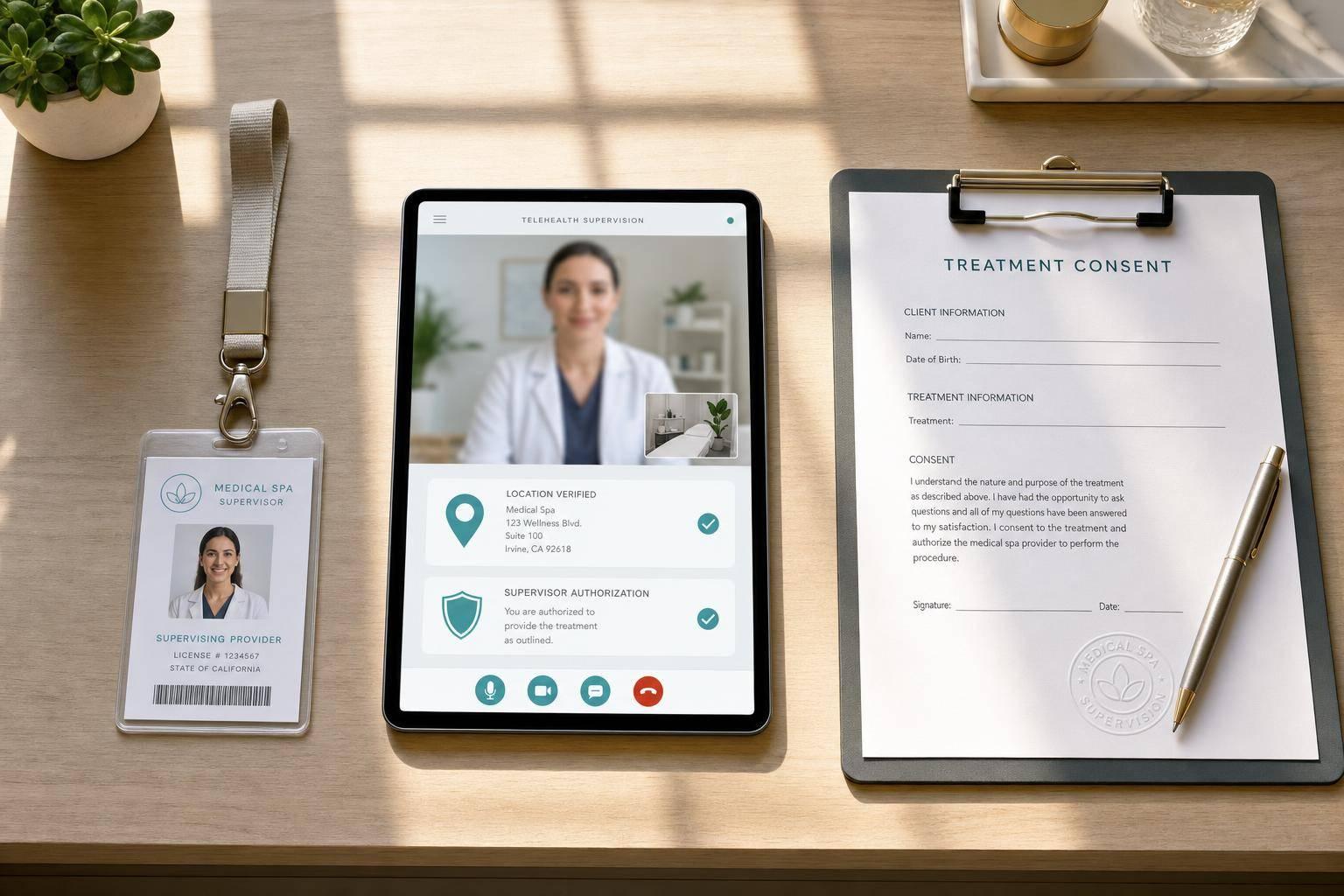

If I run telehealth for a med spa, I have to match each visit to the patient’s state, the clinician’s license, and the supervision rules behind the visit. That’s the core point. Telehealth may now account for about 13%–17% of outpatient visits, but a video call does not change state rules on licensure, delegation, prescribing, chart review, consent, or documentation.
Here’s the short version I’d want at the top of the page:
- Patient location controls the rule set. I have to build each workflow around the state where the patient is sitting during the visit.
- Care and supervision are different. A telehealth visit can look fine on screen and still fail if the NP, PA, or RN is working under the wrong setup.
- Written agreements matter. Supervision, collaboration, standing orders, chart review, escalation steps, and co-sign timing should all be in writing.
- The EMR has to prove oversight happened. Notes should show patient location, provider location, consent, modality, limits of the exam, follow-up steps, and supervisor review.
- Prescribing needs extra care. Many states allow telehealth prescribing, but some put limits on controlled drugs, weight-loss drugs, and compounded products.
- Audit files should stay ready. Keep licenses, protocols, review logs, BAAs, training records, and HIPAA records organized by state and location.
- Review the program every quarter. Check state law updates, audit 5%–10% of charts per provider, test escalations, and confirm training is up to date.
A simple way to think about it: if I can’t show who treated the patient, under whose authority, in which state, with what review rules, and what happened after the visit, then the telehealth model has a weak point.
The article below walks through that setup from state-law review to staffing, standing orders, EMR notes, and audit prep.
Review State Rules Before Building Your Telehealth Model
Once you've defined your telehealth use cases, match each one to the patient's state before you assign staff or draft protocols. The starting point is simple: build every telehealth workflow around the state where the patient is physically located during the visit.
Licensure, Patient Location, and Scope of Practice
Every clinician on your telehealth team - physician, NP, PA, or RN - must be licensed or otherwise allowed under state law in each state where patients are located during encounters. FSMB reports that physicians using telemedicine generally must be licensed or registered in the patient's state; some states use telemedicine-specific licenses or interstate registrations.
State scope-of-practice rules can also shape what each role is allowed to do. In some states, injectables, lasers, and other energy-based treatments are limited to physicians or advanced practice providers. In others, RNs may treat patients under written protocols and supervision. If you serve more than one state, these differences add up fast.
A license tracker helps keep this under control. It should store:
- License expiration dates
- State-specific permissions
- Renewal dates
Those state limits should also appear in every supervision agreement.
Collaboration Agreements, Delegation, and Prescribing Rules
Written collaboration and supervision agreements need to spell out the rules for each state you serve. That includes permitted encounter types, delegated procedures, escalation triggers, chart review expectations, and co-signature timelines.
Most states allow prescribing by telehealth without a prior in-person visit, but many still limit controlled substances, weight-loss medications, and compounded therapies. States may also spell out which telehealth modalities are allowed for prescribing. Building these rules into electronic ordering workflows and telehealth note templates helps prevent a noncompliant prescription from slipping through.
State Comparison Table: Key Telehealth Supervision Requirements
Use this table to track state rules for each service line. Update it at least quarterly.
| Field | What to document |
|---|---|
| Patient-location rule | Confirm that the governing law is tied to the patient's physical location at the time of the encounter. |
| Licensure / registration | Record whether each clinician is licensed or specially registered in that state. |
| Physician-patient relationship | Note whether a telehealth exam can establish the relationship and what modality is required. |
| In-person exam triggers | Identify services that require an in-person exam before treatment or prescribing. |
| Supervision and delegation | Document whether remote supervision is allowed and what written protocols apply. |
| Prescribing limits | Capture controlled-substance rules, online-questionnaire restrictions, and compounded-product limits. |
| Source / effective date / review date | List the board policy, statute, or regulation and the dates it became effective and was last reviewed. |
If a med spa is expanding into multiple states, every service line - injectables, laser treatments, GLP-1 programs - should tie back to this kind of matrix. When state rules conflict, use the stricter rule and document the reason in your compliance policy. Then use the matrix to shape your supervision, delegation, and prescribing workflows.
sbb-itb-02f5876
Reading about the problem? See how Prospyr solves it in one platform.
Book a DemoSet Up Supervision Structures, Standing Orders, and Staffing Models
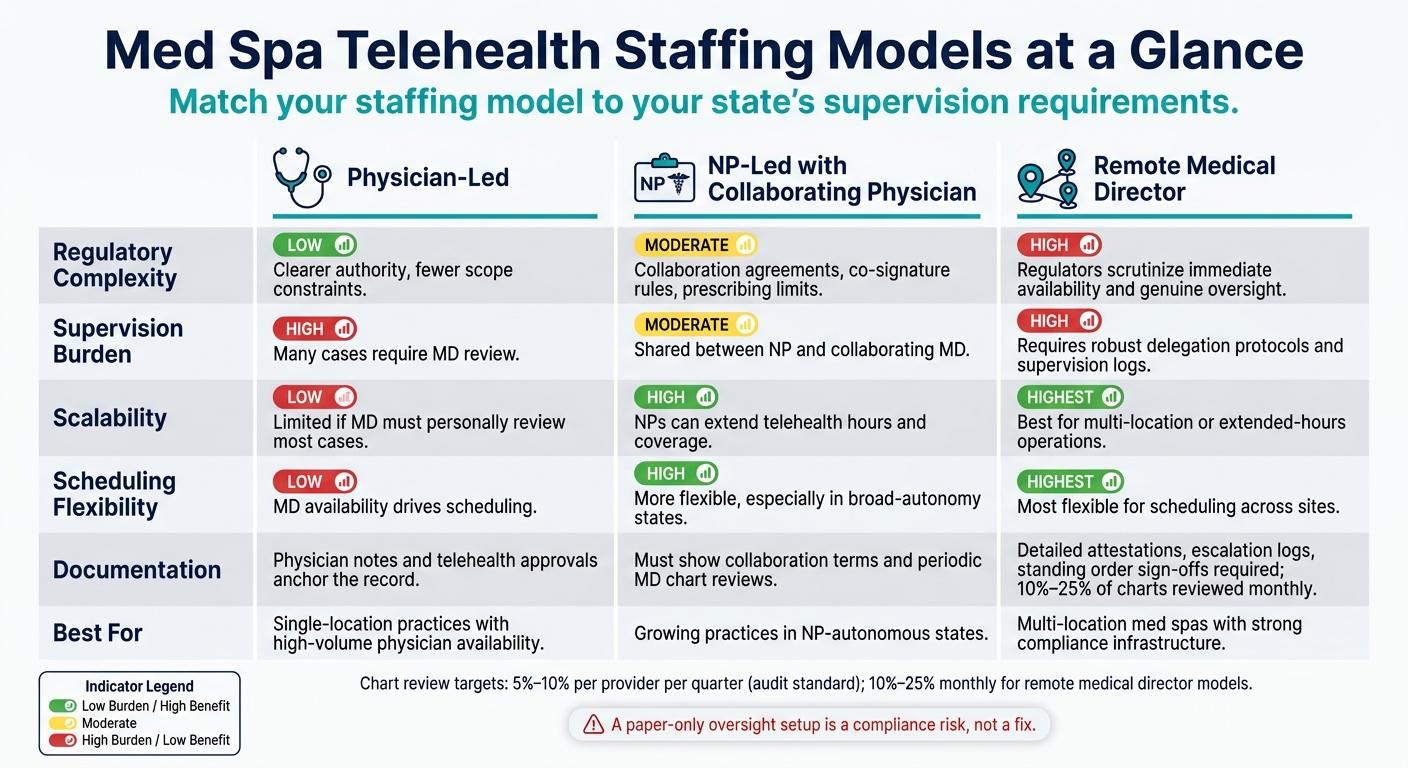
Med Spa Telehealth Staffing Models: Supervision, Scalability & Compliance
Use the matrix to assign roles, supervision, and protocol limits. Then turn those rules into day-to-day workflows, escalation points, and charting rules.
Telehealth Supervision Workflows for Physicians, NPs, PAs, and RNs
Your telehealth workflow should follow license level.
Physicians and autonomous NPs, where state law allows independent practice, handle initial telehealth consults, set treatment plans, and give final clearance before any procedure starts. PAs work under collaboration or supervision agreements, so your workflow needs to spell out which consults they can handle on their own and which ones need physician input. RNs work from standing orders and can manage structured follow-ups, like post-injection check-ins or skin care progress reviews, but they can't do the initial exam or prescribe.
One simple way to enforce this is inside your EMR. Set up separate visit types such as "MD/NP Telehealth Clearance" and "RN Protocol Follow-up." Then add scheduling rules that block treatment booking unless documented clearance is already in the chart. That way, the system does some of the heavy lifting instead of leaving it to memory.
If an RN follow-up turns up a warning sign, the case should move up right away. That includes unexpected asymmetry, signs of vascular compromise, or a severe allergic reaction. In those cases, your workflow should route the patient to a physician or NP for same-day telehealth review.
Your process should also define when the supervising clinician has to be reachable at once by phone or video. In some states, higher-risk procedures require a supervising physician to be available within the response time set by state law or protocol. For routine follow-ups run under protocol, post-visit chart review is often allowed within the required chart-review window. That cutoff should be built into both the workflow and the charting rules.
Standing Orders and Protocols for Aesthetic Treatments
A standing order should read like a short clinical protocol, not a vague instruction sheet.
At a minimum, each standing order should include:
- Patient selection and contraindications: age limits, medical history thresholds, pregnancy, infection, and other exclusion criteria
- Medication authority: which drugs or products may be used, by whom, and within what dose or concentration ranges
- Treatment parameters: device settings, maximum volumes per region, required pre-treatment assessments
- Telehealth documentation requirements: mandatory photos, standardized scoring scales, risk-benefit discussion notes
- Adverse event response steps: triage scripts, reassessment timelines, referral protocols
- In-person evaluation triggers: unexpected asymmetry, vascular compromise signs, severe allergic reactions, or failure to respond to telehealth-guided interventions
Each order should be dated and signed by the responsible physician or independent NP. It should also point back to the state supervision rules it relies on. Review standing orders at least once a year, and sooner if state rules, treatment tools, payer requirements, or major workflows change.
When you update a protocol, log why the change was made. Then retrain any affected staff before the new version goes live. That's the part many teams skip, and it's often where problems start.
Staffing Model Comparison Table
Use this table to match your staffing model to the supervision intensity your state allows.
| Model | Regulatory complexity | Supervision burden | Scalability | Scheduling flexibility | Documentation requirements |
|---|---|---|---|---|---|
| Physician-led | Lower - clearer authority, fewer scope constraints | High for the physician; many cases require MD review | Limited if MD must personally review most cases | Less flexible; MD availability drives scheduling | Physician notes and telehealth approvals anchor the record |
| NP-led with collaborating physician | Moderate - collaboration agreements, co-signature rules, prescribing limits | Shared between NP and collaborating MD | Higher; NPs can extend telehealth hours and coverage | More flexible, especially in broad-autonomy states | Must show collaboration terms and periodic MD chart reviews |
| Remote medical director | Higher - regulators scrutinize immediate availability and genuine oversight | Requires robust delegation protocols and supervision logs | Best for multi-location or extended-hours operations | Most flexible for scheduling across sites | Detailed attestations, escalation logs, standing order sign-offs required |
A remote medical director setup can help with multi-location growth, but it also gets the most regulator attention. To stay compliant, you need real availability, documented chart review programs - often aimed at 10% to 25% of charts reviewed monthly - and clear proof that staff followed standing orders and escalation paths the same way each time.
A paper-only oversight setup is a compliance risk, not a fix.
A HIPAA-compliant platform like Prospyr can support role-based scheduling, digital intake, and supervisor task logging in one record.
Every supervision decision should show up in the chart; the next section covers the note elements and audit trail.
Document Telehealth Encounters Correctly in the EMR
Telehealth visits need to be documented in a way that shows who provided care, under what authority, and under which state rules. Once supervision is set, the EMR has to spell out who did what, when it happened, and what authority applied.
Required Elements in a Telehealth Note
Set up a note template with required fields for every delegated telehealth encounter. Along with the usual clinical details, include the telehealth-specific items auditors expect:
- Patient identity and participants: Note how identity was verified and whether anyone else was present during the call.
- Telehealth consent: Refer to the signed consent form and any verbal confirmation given during the visit.
- Patient location: Record the city and state so the chart shows which laws applied at that time.
- Provider location: Record where the provider was located for jurisdiction purposes.
- Technology and modality: Note the platform used and the visit type. Example: Synchronous two-way audio/video via HIPAA-compliant platform. If the visit was audio-only, explain why and what could not be assessed.
- Reason for visit/chief complaint: Include aesthetic or wellness goals, safety concerns, and any procedure under review.
- History and relevant prior treatment history: Include medical history, review of systems, and any prior aesthetic treatment.
- Findings, limitations, assessment, and plan: State what was seen, what could not be assessed because of telehealth limits, and how that affected the plan.
- Time of encounter and duration: Record service time when needed for compliance and billing.
- Follow-up instructions and return precautions: Note timing, visit type, and symptoms that should lead to an urgent call.
For aesthetic visits, also reference any pre-visit photos uploaded through the secure patient portal and include the date of those images.
Supervision Attestations, Co-Signatures, and Review Logs
When a delegated clinician - NP, PA, or RN - handles a telehealth encounter, the supervising physician’s review has to appear in the chart in a way that means something. A simple co-signature doesn’t do much unless it says what was reviewed and whether the plan was approved or changed.
Have the supervisor document:
- what was reviewed
- whether the plan was approved
- any changes that were made
The co-signature timeline should match the delegation model described above. Route delegated notes for co-signature within the state-required window, and use 72 hours as the internal target. The system should also log who wrote the note, who co-signed it, and the exact timestamp for each action. That’s the kind of detail auditors check when they want to confirm oversight was real and on time. Those timestamps should also feed into your audit file.
Escalations need their own chart entries too. If an NP spots a skin lesion during a telehealth consult and the physician advises delaying treatment and booking an in-person exam, that exchange and the outcome belong in the medical record - not buried in a text thread or left as a verbal side note.
HIPAA Controls and Integrated Recordkeeping
Documentation falls apart fast if the systems holding it aren’t secure. Three controls sit at the center of telehealth recordkeeping: BAAs, RBAC, and access logs.
Every system that touches protected health information (PHI) - your telehealth video platform, intake forms, scheduling tool, photo storage, messaging system, and any integration that handles PHI - needs a signed Business Associate Agreement (BAA) before it goes live. If even one vendor is missing a BAA, that’s a compliance gap.
Role-based access control (RBAC) is the main technical safeguard here. Front-desk staff should be limited to scheduling and demographic data, not detailed clinical notes. Clinicians should have full chart access. Supervisors should have review and co-signature permissions. Write these settings into your system configuration records, and review them any time someone’s role changes.
Keep access logs, review them on a routine basis, and flag unusual access.
Prepare for Audits and Maintain Ongoing Compliance
Documentation is only one piece of compliance. After a chart is signed and stored, the next test is simple: can you pull proof fast? Once your documentation is set, the file needs to stay audit-ready and easy to retrieve on demand.
Build an Audit-Ready Telehealth File
Group these documents by location or state so you can pull them fast during an audit. Use the same file structure across every location. That way, an audit doesn't hinge on who happens to remember where something lives.
| Document Category | What to Include | Track by location/state |
|---|---|---|
| Active licenses & credentials | All providers (MD, NP, PA, RN); expiration dates; states covered | ☐ Current (exp. date: ______) |
| Collaboration/supervision agreements | Supervision level, chart-review rate, telehealth terms, renewal date | ☐ On file (renews: ______) |
| Standing orders & protocols | Per treatment type; supervising MD signature; last revision date | ☐ Updated (rev. date: ______) |
| Telehealth SOPs | Consent, identity verification, modality, outage and escalation response | ☐ Distributed to staff |
| Supervision & chart-review logs | Reviewer name, dates, review rate, corrective actions | ☐ Current (last review: ______) |
| Informed consent forms | Telehealth-specific; e-signature or attested verbal with timestamp | ☐ Archived with encounter notes |
| Staff training records | HIPAA, telehealth workflows, device security; completion dates | ☐ Up to date (last training: ______) |
| HIPAA security documentation | Risk analysis (updated in the last 12 months), BAAs, remediation plans | ☐ Documented & current |
One detail matters more than it may seem: the chart-review rate in your logs should match the rate listed in the collaboration agreement. Auditors check both side by side.
Set a Quarterly Compliance Review Process
Run this on a quarterly cycle. Each review should cover four areas: regulatory updates, chart audits, escalation testing, and training verification.
Start with the rules. Check whether telehealth and prescribing rules in each patient state have changed, and confirm that your collaboration agreements and standing orders still match current requirements.
Then move to chart review. Audit 5%–10% of telehealth charts per provider, and log the findings, corrective actions, and any retraining that follows.
After that, test escalation pathways with a mock scenario. Staff should know how to reach the supervising provider and what to do if a patient needs in-person care.
Last, verify that staff completed all required training modules and record any gaps.
The people in the room should include the medical director, collaborating providers, a compliance or practice manager, and operations or IT. Larger groups may want a formal compliance committee, plus meeting minutes and a written action plan.
Platforms like Prospyr can help support this cycle by centralizing EMR audit trails, routing charts for co-signature review, and tracking credential expiration dates. That cuts down on the manual follow-up that often slips between quarterly reviews.
That rhythm helps keep supervision, documentation, and training in sync.
Conclusion: Core Controls Every Med Spa Needs
Quarterly review, clean documentation, and current credentials help keep the model audit-ready. Telehealth enforcement has intensified, with DOJ and HHS-OIG making it one of their top priorities. Med spas that treat compliance like a steady operational habit are usually the ones that stay ahead of problems.
FAQs
What if patients travel between states?
The key rule is simple: the provider must be licensed in the state where the patient is physically located during the telehealth visit. In most cases, that state is treated as the place of service.
To stay compliant, verify the patient’s location at each session, confirm that the provider holds a license in that state or qualifies through an interstate compact, and follow that state’s consent, disclosure, and privacy rules.
When does telehealth require in-person follow-up?
In-person follow-up is needed when a virtual assessment can’t fully meet the patient’s needs or check physical signs like swelling or skin texture.
It can also be required by state law. That includes first-visit rules in states like Tennessee and Arkansas, as well as rules tied to prescribing controlled substances under the Ryan Haight Act and certain state mandates.
For mental health services, the patient must have an in-person visit within six months of the initial telehealth service, and then once a year after that.
How often should telehealth charts be audited?
Audit telehealth charts quarterly. Use those reviews to check key documentation, including patient consent, confirmed patient and provider locations, visit modality, and clinical details that support medical necessity. It’s also a good way to spot documentation or coding gaps early, before they turn into bigger problems.
On top of that, run a broader telehealth workflow compliance review at least every six months. Telehealth rules can shift fast, so these check-ins help you stay current and keep your process on track.
Related Blog Posts
Free PDF guide + worksheets
Build your state opening file.
Get the state highlights, linked official sources, service-by-service licensing worksheet, ownership questions and opening checklist in one printable guide.
- ✓ State-specific decisions and next steps
- ✓ Credential and supervision worksheet
- ✓ A place to track approvals, owners and renewals