Calibration Requirements for Aesthetic Devices
Guidance on calibration intervals, daily checks vs formal calibration, records, and risk-based schedules for lasers, RF, and skin imaging.
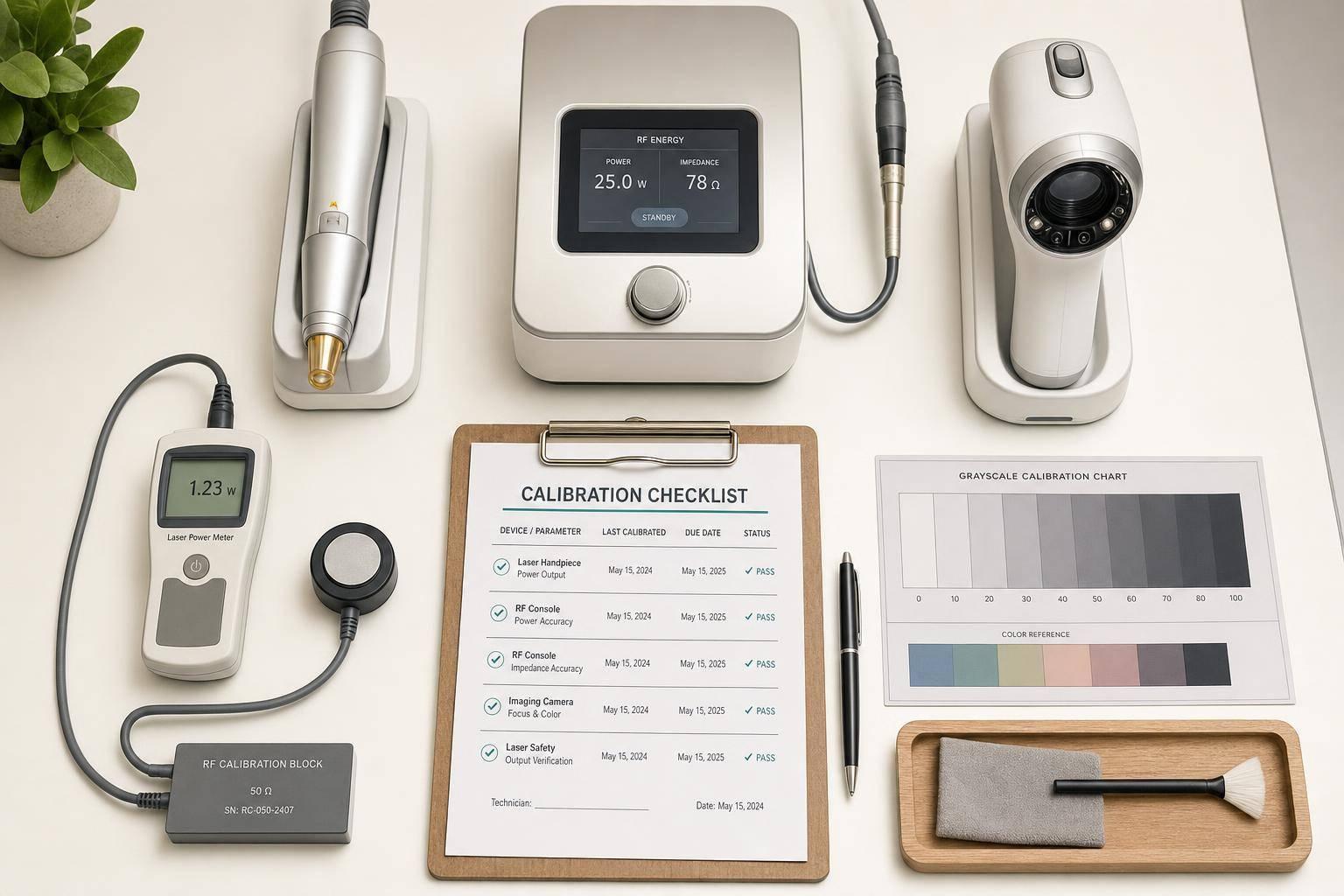

If a device says one thing and delivers another, your clinic takes the risk. In short: I need to calibrate aesthetic devices on the maker’s schedule, keep service records in one place, separate daily checks from formal calibration, and lock a device out of use when it fails.
Here’s the article in plain terms:
- Calibration is not routine maintenance. Cleaning, visual checks, and startup self-tests help, but they do not prove output accuracy.
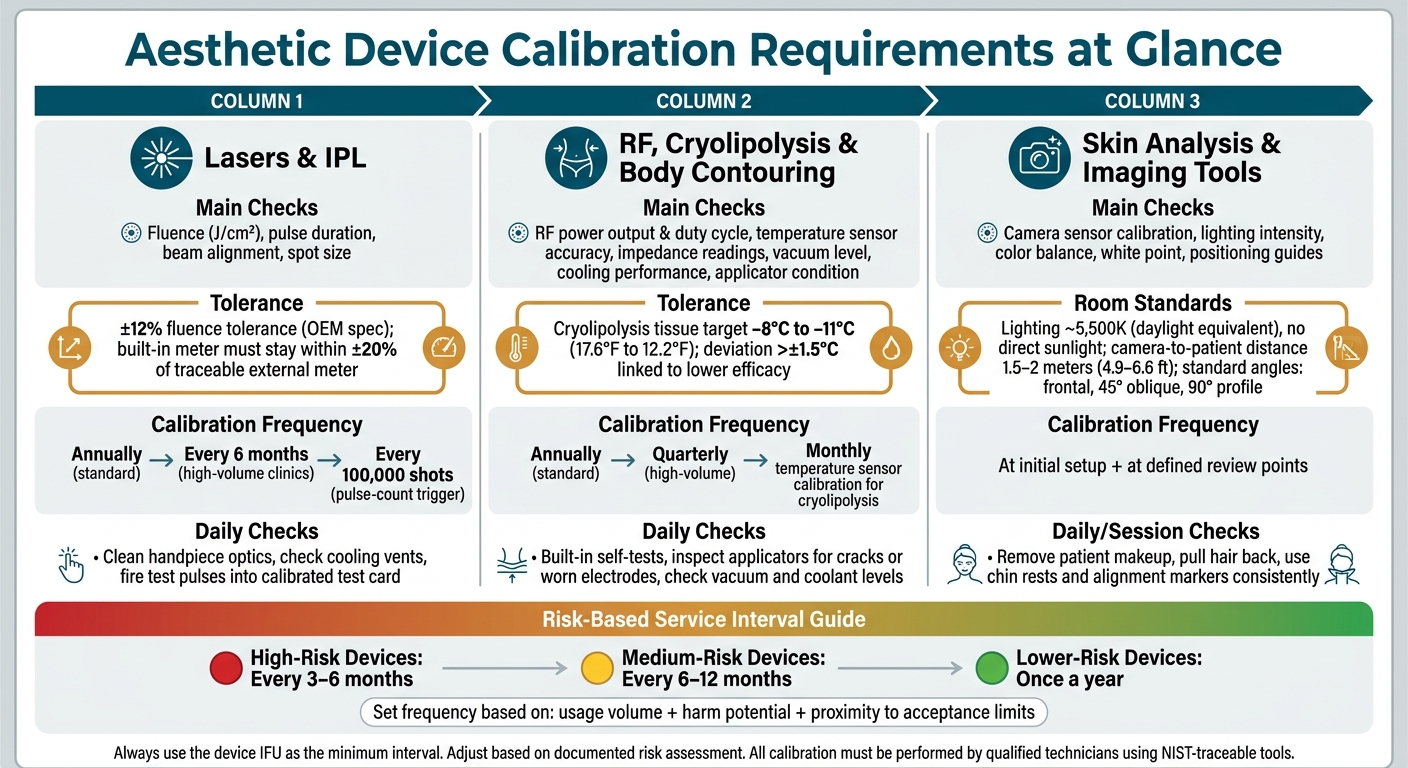
- Lasers and IPL need output and alignment checks. Many systems use annual service, while high-use clinics may move to every 6 months. A common OEM target is about ±12% fluence tolerance.
- RF, cryolipolysis, and body contouring devices need sensor checks. Temperature, power, impedance, cooling, and vacuum matter. For cryolipolysis, tissue targets often sit around −8 °C to −11 °C (17.6 °F to 12.2 °F), and drift beyond ±1.5 °C can hurt results.
- Skin analysis tools need room control too. Photos only compare well when lighting, distance, angles, and patient prep stay the same.
- Records matter as much as the test. I should keep the asset ID, serial number, last service date, next due date, measured values, pass/fail result, technician name, and proof of traceable test tools.
- Risk should shape frequency. High-use, high-harm devices often need checks every 3 to 6 months. Lower-risk devices may be checked once a year.
- Software helps stop missed dates. A device log with reminders, linked certificates, and status tracking helps show control during an inspection.
A fast way to think about it:
| Device type | Main check | Common timing |
|---|---|---|
| Lasers / IPL | Fluence, pulse, alignment, spot size | Yearly or every 6 months |
| RF / body contouring | Power, temperature, impedance, cooling | Yearly to quarterly |
| Skin imaging | Lighting, color, distance, positioning | At setup and at set review points |
The core point is simple: measured output should match the setting on the screen, and I need records that prove it.
Aesthetic Device Calibration: Intervals, Checks & Tolerances by Device Type
2. Calibration rules by device type
Use the device IFU, service manual, or authorized service guidance to set the service interval.
Lasers and IPL: output, fluence, and alignment checks
For lasers and IPL, the main calibration items are energy output/fluence (J/cm²), pulse duration, beam alignment, and spot size. If output drifts or the optics slip out of alignment, the dose delivered to tissue no longer matches what appears on the screen. Typical OEM specs allow about ±12% fluence tolerance. Built-in meters should stay within ±20% of a traceable external meter. If they fall outside that range, the device needs recalibration.
Many laser and IPL systems call for annual service, while high-volume clinics often shift to six-month intervals. Some manufacturers also tie service to pulse counts, such as every 100,000 shots for high-power systems. If the device has been repaired, shipped, or shows signs of drift, calibration should be handled by a qualified technician or authorized service partner.
Daily operator checks are pretty simple, but they matter:
- Clean handpiece optics with manufacturer-approved wipes
- Check cooling vents
- Fire test pulses into a calibrated test card, gel pad, or dummy load
Those intervals don't mean much if the clinic can't show they were followed.
RF and body contouring systems: power, temperature, impedance, and applicator checks
RF tightening, cryolipolysis, and HIFEM systems rely on sensor accuracy and thermal control to deliver steady results. The main items to verify are RF power output and duty cycle, temperature sensor accuracy, impedance readings, vacuum level and cooling performance for cryolipolysis, and applicator condition. Sensor drift is a common failure point. When temperature readings no longer match true tissue temperatures, the risk of burns, frostbite, or uneven results goes up, often without any clear warning on the device screen.
Most systems need annual service, while high-volume clinics often move to quarterly calibration. Cryolipolysis devices target tissue temperatures between −8 °C and −11 °C (17.6 °F to 12.2 °F), and deviations greater than ±1.5 °C are linked to lower efficacy. Clinics should calibrate cryolipolysis temperature sensors monthly or follow manufacturer guidance, using traceable thermal probes.
Staff should run built-in self-tests, inspect applicators for cracked housings or worn electrode surfaces, and check vacuum and coolant levels each day. Any repair, firmware update, or component replacement calls for a full recalibration by an authorized technician before the device returns to service.
Skin analysis tools: image, lighting, color, and positioning checks
Imaging systems come with a twist that energy devices don't: both the device and the room have to stay controlled. Camera sensor calibration, lighting intensity, color balance, white point, and positioning guides all shape whether a follow-up image can be compared to a baseline in a meaningful way. If any of those shift, a treatment can look better or worse than it was.
Clinical photography standards state that before-and-after photos have clinical value only when they are taken under identical conditions: lighting, camera, settings, patient posture, and expression.
For room setup, manufacturers usually recommend controlled lighting with no direct sunlight and a color temperature of about 5,500 K (daylight equivalent). Keep camera-to-patient distance at 1.5 to 2 meters (about 4.9 to 6.6 feet) for full-face imaging, with standard views at frontal, 45° oblique, and 90° profile angles. Patient prep should also stay the same at every visit - remove makeup, pull hair back with a headband, and use chin rests or alignment markers the same way each time.
Next, clinics need a record system and performance analytics that show what was calibrated, when, and by whom.
sbb-itb-02f5876
Reading about the problem? See how Prospyr solves it in one platform.
Book a Demo3. Service intervals and inspection records clinics should keep
How to set service intervals using manufacturer guidance and device risk
Device checks only mean something when they sit inside a set service schedule. Start with the IFU and treat it as the minimum interval. Don't go past that interval unless you have a documented risk reason. Arizona's Department of Health Services, for example, says laser calibration frequency can't exceed the manufacturer's recommendation, and user manuals plus calibration records must stay available in a safety binder.
From there, adjust the schedule based on three things: how often the device is used, what happens if it drifts, and whether past results came close to the acceptance limit. A device that ranks high on all three - like a high-energy fractional laser used several times a day - should be checked more often.
Published risk-based models group intervals like this:
- High-risk devices: every 3–6 months for preventive maintenance and calibration
- Medium-risk devices: every 6–12 months
- Lower-risk devices: once a year
It also makes sense to tighten intervals for the parts most likely to drift, such as output, sensors, optics, and positioning systems. If a device keeps drifting close to its acceptance limits, shorten the interval and note the reason in the device's quality file.
If the clinic sets an interval shorter than the manufacturer's limit, write that decision down. Inspectors usually want to see a safety-based reason that follows a system, not a random choice. After that, the record has to show each service event clearly.
What inspectors usually check in device records
A service schedule only holds up if every calibration is logged in one place. When inspectors review device records, they usually want a full trail from installation through the most recent service event. For each calibration entry, they expect core details like these:
| Record Element | What It Should Show |
|---|---|
| Asset ID, model, serial number | Ties the record to one specific device |
| Installation date | Establishes the compliance timeline |
| Last calibration date & next due date | Confirms the schedule is active |
| Service vendor / technician | Identifies who performed the work and their qualifications |
| Test equipment traceability | Links to a NIST-traceable reference and its calibration date |
| Measured values vs. acceptance limits | Shows explicit pass/fail results, not just "OK" |
| Corrective actions | Documents what was done if the device failed or approached limits |
| Lockout documentation | Shows the device was removed from use until corrected |
Lockout records are a common weak spot. Inspectors want proof that the device was taken out of service right away, then put back only after it passed a retest. In practice, that means a dated lockout tag, a status change in the asset register, and a written return-to-service decision after a passing retest.
FDA data-integrity expectations, often summed up as ALCOA+, shape these records too. Data must be Attributable, Legible, Contemporaneous, Original, Accurate, Complete, Consistent, Enduring, and Available. Whether the clinic uses paper or digital files, the record needs to stay complete and traceable. Inspectors look for a clean chronological trail that lets them follow the device through each calibration and service event without gaps.
4. How to track calibration in clinic software
What to track for each device
Once you’ve set up the device log, your software can do the heavy lifting. It can turn that log into reminders, status alerts, and a full service history. Use MM/DD/YYYY so dates stay clear for everyone.
The table below covers the fields that matter most for software-based tracking:
| Field | Purpose |
|---|---|
| Responsible owner | Names the staff member accountable for follow-up |
| Risk level / usage | Helps guide monitoring frequency |
| Manufacturer service interval | Sets the minimum calibration frequency |
| Reminder cadence | Defines when alerts fire before the due date |
| Linked documents | Points to certificates, test results, and technician reports |
| Current status | Shows whether the device is active, on hold, or cleared |
Status updates should stay linked to the device record, so staff can check right away whether a device is active, on hold, or cleared. It also helps to keep certificates, test results, photos, and technician reports in that same record. When everything lives in one place, follow-up gets a lot easier.
Using Prospyr for reminders, tasks, and records
The next step is automation. Due dates shouldn’t live in someone’s head or on a sticky note.
For calibration tracking, Prospyr can assign reminders, store documents, and track follow-up. It can also assign recurring calibration tasks, attach service documents, and send due-date reminders.
If a device fails a check, log the issue in the record, assign the next step, and document return-to-service approval in that same device file. That keeps reminders, tasks, and records tied to the device instead of scattered across emails or separate systems.
5. Conclusion: A simple calibration policy for clinics
A calibration policy needs four parts: manufacturer-based intervals, a clear split between daily checks and formal calibration, inspection-ready records, and software reminders. Put together, that keeps calibration under control without adding extra hassle.
Daily checks and formal calibration do different jobs. Clinics need both, and they should be recorded separately. Formal calibration should be done by qualified technicians with traceable tools.
For each device, that means keeping the service report, measured values, technician name, and next due date in one device record. That kind of recordkeeping also makes troubleshooting faster and inspections a lot cleaner.
With that system in place, clinics can stop missed service dates before they turn into compliance issues. Calibrated devices lead to more predictable treatment outcomes, which means fewer retreatments, fewer complications, and less downtime. Prospyr helps keep this manageable by linking reminders, tasks, and service documents to each device record. The goal is simple: no device reaches its due date unnoticed.
FAQs
Who can perform formal calibration?
Formal calibration must be handled by a professional calibration provider. Clinic staff - including clinicians and technicians - should not try to recalibrate or repair the device on their own.
If a device fails a calibration check or starts giving inconsistent results, the clinic should contact the designated provider. The device owner handles the service schedule and coordinates the work, while the medical director gives final approval before the device goes back into service.
What happens if a device fails calibration?
If an aesthetic device fails calibration, it is out of tolerance and must be taken out of service at once. Mark it OUT OF TOLERANCE – DO NOT USE and keep it separate so no one uses it by mistake.
Record the failure, look into the cause, and review any procedures completed since the last successful check. The device may go back into service only after written proof shows it is again within accepted limits and staff has given formal approval.
How do I set a risk-based calibration schedule?
Follow the manufacturer’s instructions for use (IFU) and group devices based on how much they could affect patient care. Then assign each device a risk tier - low, medium, or high - and use that tier to set calibration intervals, escalation timelines, and the response steps for out-of-tolerance events.
It also helps to track each asset’s status at all times, such as active, due for calibration, or out of service. A central system like Prospyr can handle reminders automatically, log service history, and block scheduling for devices that haven’t been formally cleared.