Facility License Renewal Guide for Med Spas
90-day med spa facility renewal checklist: deadlines, documents, inspections, staff roles, and recordkeeping for on-time compliance.

If your med spa facility license expires, you may have to stop treatments, cancel appointments, and deal with fines. In plain terms, I’d treat renewal like a fixed compliance job: confirm the deadline, gather every required document, file early, answer agency questions fast, and save proof of everything.
Here’s the short version:
- Facility renewal is separate from provider licenses. Your nurses, physicians, or other clinicians may be current, but the location itself can still fall out of compliance.
- Deadlines matter. The article points to Florida’s rule that renewal must be received at least 60 days before expiration, with late fees of $50 per day up to $500.
- Small record errors can slow approval. A missing suite number, name mismatch, or wrong ownership detail can trigger correction requests.
- Inspections can hold up renewal. Fire safety, infection control, equipment logs, and staff training records are common review points.
- One missed task can become a business problem. Tennessee records in the article show a $2,300 civil penalty tied to late renewal and practice on an expired license.
- The safest workflow is simple: set 90-, 60-, and 30-day checkpoints, assign one owner per task, track local permits too, and keep a full renewal file for 5 to 7 years.
A few numbers stand out. The article notes that 77% of non-deemed ASCs had at least one deficiency in their most recent survey, and 67.6% of 68 ambulatory surgical centers reviewed by the CDC had at least one infection-control lapse. If your med spa offers injectables, laser services, or other higher-risk treatments, paperwork and site-readiness matter even more.
| What I’d focus on first | Why it matters |
|---|---|
| Expiration date and agency | Tells you the filing window and current rules |
| State and local permits | These may renew on different dates |
| Names, addresses, ownership | Mismatches often delay processing |
| Inspection reports | Some agencies want current reports before filing |
| Fees and receipts | You need proof of payment and submission |
| Staff roles | Clear task ownership helps stop last-minute issues |
If I were running the process, I’d aim to submit well before the deadline, keep one shared checklist, and log every document, payment, email, and approval in one place.
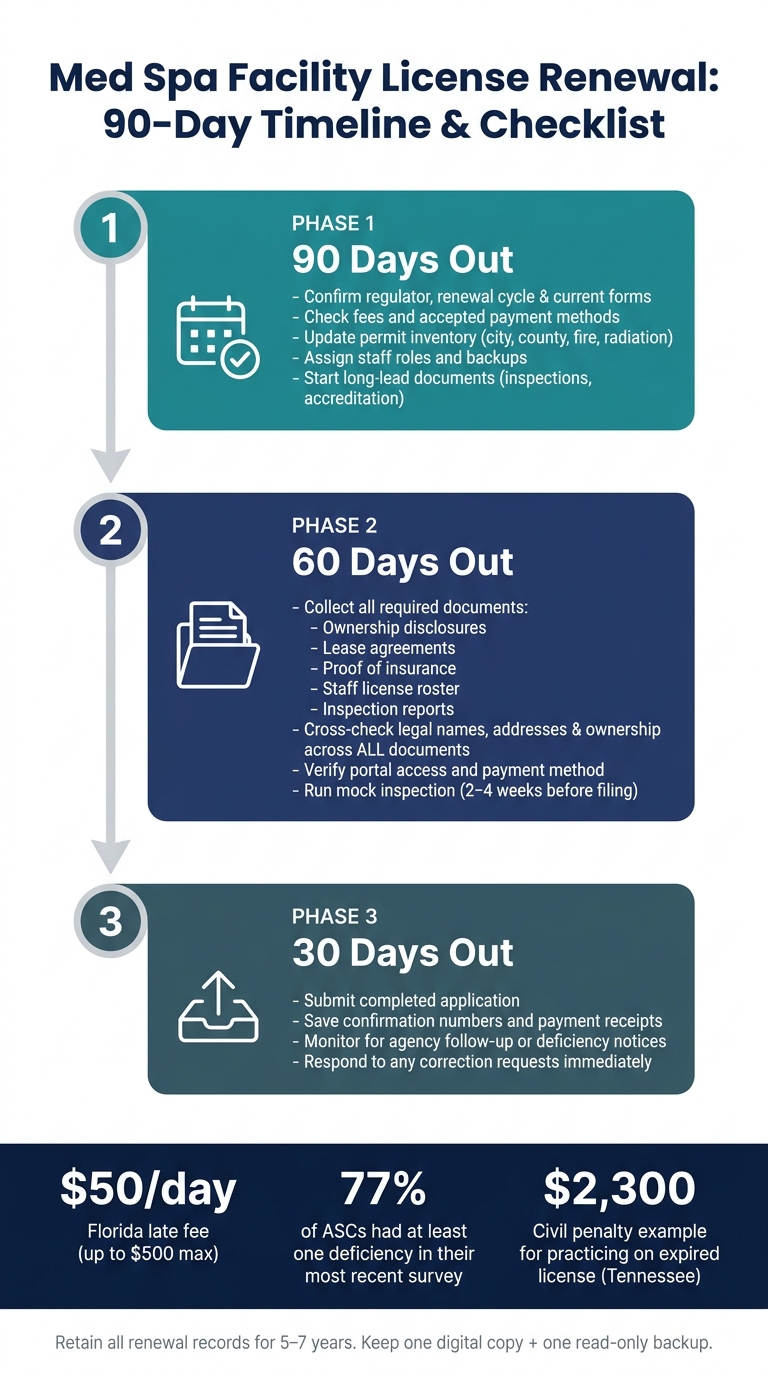
Med Spa Facility License Renewal: 90-Day Checklist & Timeline
1. Confirm your renewal cycle, deadlines, and state agency requirements
Start with your current facility license. Write down the issuing agency, the statutory authority, and the expiration date. Those three details are your starting point for the whole renewal process. Once you have the expiration date in front of you, pull the current renewal instructions from that regulator.
Find the right regulator and current renewal instructions
Facility licensing can sit with a state health department, a health facility division, or another regulator, depending on the services you provide. Go straight to the agency’s official website and download the current renewal application form. Forms change over time, so use the latest version. While you’re there, check whether the renewal must be filed online or by mail. Also verify accepted payment methods and the required currency.
Check whether local permits renew on a different schedule
Then review every local approval tied to that same location. City or county business licenses, fire safety permits, and radiation equipment registrations may all come from different agencies and carry different expiration dates. In many cases, those dates won’t match the state license.
A simple permit inventory helps keep this straight. Include:
- Issuing authority
- License or permit number
- Expiration date
- Lead time needed for renewal
Track each item on its own. One missed local permit can hold up the full facility renewal.
Build an internal timeline 90, 60, and 30 days before expiration
Work backward from the expiration date and set fixed checkpoints at 90, 60, and 30 days. That buffer gives your team room to collect documents, fix missing items, and respond if the agency asks for more.
Here’s what that can look like if the license expires on August 31, 2026:
| Milestone | Target Date | Key Actions |
|---|---|---|
| 90 days out | June 2, 2026 | Confirm the regulator, renewal cycle, current forms, and fees; update the permit inventory; assign staff roles |
| 60 days out | July 2, 2026 | Collect required documents, such as ownership disclosures, lease agreements, management contracts, proof of insurance, and any current inspection reports; confirm staff licenses and supervision arrangements if needed; verify portal access and payment method |
| 30 days out | August 1, 2026 | Submit the completed application; save confirmation numbers and payment receipts; monitor for agency follow-up |
Florida law shows why this timing matters. State rules require renewal applications to be received at least 60 days before expiration, and late filings trigger a $50 per day late fee, capped at 50% of the license fee or $500.
Renewal terms change from state to state, so check your exact cycle before you set deadlines. Get that confirmation in writing from the agency.
sbb-itb-02f5876
2. Gather forms, documents, and fees before you file
Once your timeline is set, the next step is putting together the renewal packet. If even one required item is missing, the application can get stuck. In many cases, regulators treat an incomplete packet as a reason to hold approval until everything is turned in.
Prepare the standard renewal packet
Use the deadlines from Section 1 to pull the packet together before you file. In most cases, that means gathering the current renewal form, business registration, local business license, licensed-staff roster, insurance certificates, and any required inspection reports.
If your med spa provides more clinical services, such as laser treatments or injectables, plan for extra paperwork. That can include accreditation documentation, infection control policies, and equipment maintenance logs.
Match legal names, addresses, and ownership records across documents
Before you submit anything, compare every document line by line. Your exact legal entity name, any DBA, suite number, and ownership records should match across the facility license, state business records, tax ID records, lease, and insurance certificates.
This is one of those details that sounds small until it slows everything down. Michigan's licensing guidance specifically points to incorrect or incomplete addresses, including missing suite numbers, as a common mistake that causes delays. It also notes that address mismatches can't be fixed inside the renewal application itself. A separate change request is required. Missouri's renewal system says much the same thing: licensees should not change address information in the renewal portal and must file a separate business update if something is wrong.
A mismatch between your DBA and your registered entity name can trigger a correction request. So can a lease that says "Unit B" while the license says "Suite B." Little wording gaps like that can cost you days or even weeks.
Record the fee, payment method, and receipt
Check the regulator's current fee schedule right before you pay. Fees and surcharges can change from one year to the next. Also confirm which payment methods the agency accepts. Some allow online credit card or debit card payments, electronic checks, or mailed checks and money orders. Others still require paper checks for certain facility types. Many agencies also state that renewal fees are non-refundable if the packet is incomplete or incorrect.
After payment, record the date, amount, payment method, and confirmation number in your compliance file right away. Download the receipt or save a screenshot. It takes a minute, and it can save a scramble later.
Use a document control table to track status and procurement time
Start with the items that take the longest to get. Fire and health inspection reports, accreditation surveys, and insurance policy updates often take several weeks, so get those moving well before the deadline.
| Document | Issuing Authority | Frequency | Internal Owner | Target Date |
|---|---|---|---|---|
| Facility license renewal application | State health department | Per license cycle | Compliance coordinator | 45 days before expiration |
| Business entity registration / annual report | Secretary of State | Annual | Office manager | 60 days before expiration |
| Medical director license copy | State medical board | Per license cycle | Medical director | 60 days before expiration |
| Staff license roster and copies | State licensing boards | Per license cycle | Compliance coordinator | 60 days before expiration |
| General and malpractice insurance certificates | Insurance carrier | Annual | Office manager | 60 days before expiration |
| Required inspection report | Local fire or health dept. | Annual (within 12 months) | Facility manager | 90 days before expiration |
| Accreditation documentation (if applicable) | AAAASF / Joint Commission | Per accreditation cycle | Medical director | 90 days before expiration |
Flag anything with a longer lead time so it gets started at the 60- to 90-day mark. Keep these files ready in case an inspector or agency reviewer asks for backup. Once the packet is complete, move on to inspections and agency follow-up.
Reading about the problem? See how Prospyr solves it in one platform.
Book a Demo3. Handle inspections, accreditation, and agency follow-up
Many states want proof that your facility meets fire safety, health, infection control, or clinical standards. In many cases, you need that proof before you file your renewal.
Check whether current inspection reports are required
Inspection rules change by state and by the services you offer. Common review types include fire marshal inspections, local health department inspections, environmental health reviews, and surveys or clinical oversight reviews for higher-acuity facilities.
Some inspections are routine. Others happen on a set cycle or after a complaint. That’s why it’s smart to check each agency’s validity window and confirm whether you need an approved inspection before filing. Once you know that, set a document deadline and assign one person to own each inspection item.
Prepare for common inspection and survey requests
Run a mock inspection 2 to 4 weeks before filing. If you find gaps, put them into your correction log before the renewal packet goes out. That gives you a chance to fix issues while there’s still room to move.
Inspectors and renewal reviewers often ask for:
- Written policies and procedures, plus emergency preparedness plans
- Fire safety records, including extinguisher service tags, sprinkler and alarm testing, evacuation plans, and clear emergency exits
- Equipment maintenance and calibration logs
- Infection control procedures, sanitation logs, and sharps disposal records
- Proof of staff training
If your med spa offers delegated medical procedures like injectables or laser services, add supervision protocols, medical director agreements, adverse event response procedures, and staff competency records.
The risk of paperwork gaps isn’t small. Federal oversight data for ambulatory surgical settings found that 77% of non-deemed ASCs had at least one deficiency during their most recent survey, and infection control deficiencies accounted for roughly one-fifth of all deficiencies. A separate CDC review found that 67.6% of 68 ambulatory surgical centers had at least one infection-control lapse. If your med spa performs invasive procedures, expect that same close review.
Respond quickly to deficiencies, corrections, and agency questions
When an agency sends a correction request, deficiency notice, or Statement of Deficiency, move fast. Log the notice, assign one owner per item, and set an internal due date that comes before the agency’s deadline.
Your response should include proof, such as emails, revised policies, photos, or other records showing the fix is done. A slow or partial reply can delay renewal, lead to added review, or move the matter toward enforcement. These response tasks should go to the staff owners named in the next section.
How requirements differ by facility type for more invasive services
As your service mix becomes more invasive, the inspection and documentation load usually gets heavier. A med spa offering standard aesthetics services will often need fire safety records, sanitation logs, and basic staff documentation. Once you add injectables, laser treatments, or surgical procedures, agencies often expect more.
That can include:
- Formal infection control programs, sterilization records, and detailed medication handling logs
- Medical director agreements, delegation protocols, and staff competency records
- Accreditation documentation, which several states, including Colorado, Iowa, Massachusetts, Texas, and Nevada, accept as approved accreditation in lieu of a state licensing inspection at renewal
Even when a state accepts approved accreditation instead of a renewal inspection, that doesn’t mean you’re off the hook. Facilities can still face complaint-driven investigations and spot checks, so staying audit-ready between renewal cycles matters.
4. Assign staff roles and build a renewal workflow that prevents lapses
Renewal lapses usually happen when no one clearly owns the work - not because people don't care. The fix is simple: give every task one owner, one backup, and one deadline.
Define who owns forms, fees, inspections, and final sign-off
Use a one-page responsibility matrix that shows a primary owner, backup, and approver for each task. That way, no one has to guess who handles what when renewal season starts.
Common role assignments look like this:
- The facility owner or managing physician handles final sign-off and any high-risk attestations
- The practice administrator manages deadlines and filing
- The medical director signs any state-required clinical attestations
- The clinical lead keeps training and policy records in order
- Front-office or compliance staff handle portal uploads and correspondence
That may sound basic, but it's the kind of basic step that saves you from last-minute scrambling.
Create a written renewal checklist and escalation path
Turn the renewal process into a standard operating procedure (SOP) with numbered steps, named owners, and internal due dates tied to your renewal calendar. Each step should require written confirmation - an email, a saved receipt, or a signed form - so you have a record showing when each milestone was done.
Your SOP should also spell out what happens when work stalls. For example:
- At 60 days, alert ownership if the application has not started
- At 30 days, escalate missing documents or approvals
- At 14 days, treat the renewal as urgent and reassign resources
Also, name a backup for every critical role. If the primary owner is out near a deadline, the handoff should happen automatically, not after a round of panic emails.
Use centralized tracking for reminders, documents, and communications
Spreadsheets and long email threads tend to fall apart under deadline pressure. A HIPAA-compliant platform like Prospyr can keep renewal tasks, reminders, documents, and confirmations in one audit trail.
That matters for a simple reason: when everything lives in one place, it's much easier to see what's done, what's late, and what's still waiting on review.
Reactive vs. planned renewal management
On-time filing starts with a plan before the deadline shows up.
| Aspect | Reactive (wait for agency notices) | Planned (internal calendar & workflow) |
|---|---|---|
| Workload | High - compressed timelines, rushed document gathering | Low - tasks spread across the renewal calendar with clear owners |
| Deadline risk | High - no internal warning before expiration | Low - automated reminders and escalation triggers |
| Visibility across licenses | Low - status unknown until a notice arrives | High - centralized registry shows all expiration dates |
| Staff accountability | Unclear - tasks assigned ad hoc under pressure | Clear - named owners and backups documented in SOP |
| Audit readiness | Weak - records scattered or incomplete | Strong - confirmations and documents stored centrally |
A documented workflow also makes final packet storage and next-cycle tracking faster.
5. Keep records after submission and prepare for the next cycle
Once the renewal is filed, the job shifts from submitting paperwork to keeping clean records. Archive the final packet, log the renewed license, and update the next expiration date.
Save the final application package and agency confirmations
Keep the signed application, attachments, payment record, proof of submission, and all agency emails or letters in one folder. Use the same controlled file system you used during renewal prep. When the renewed license arrives, place it in that folder too.
Good file names save time. Something like 2026_Renewal_Application.pdf and 2026_Renewal_Payment_Receipt.pdf makes records much easier to find during an audit or an insurance credentialing review. Minnesota's hospital license renewal instructions say applicants should "Keep a copy of the application and attachments for your records."
It also helps to set a written retention policy for renewal files of 5 to 7 years. Keep one main digital copy and one read-only backup so the records stay easy to access and protected for the full retention period.
If you want everything in one place, a HIPAA-compliant platform like Prospyr can centralize renewal files, user permissions, and audit trails.
Update the compliance calendar for the next renewal cycle
As soon as approval comes in, reset the calendar for the next cycle. When the renewed license arrives, add the new expiration date to your compliance calendar and rebuild the 90-day, 60-day, and 30-day reminders.
Then take a quick look back at the process. Note what slowed the filing, what held up the agency response, and where job ownership was fuzzy. After that, update the SOP so the next renewal cycle runs with less friction.
Conclusion: A clear process for on-time med spa license renewal
Facility license renewal is a repeatable compliance process, not a last-minute scramble. Start by confirming the right state regulator, the renewal cycle, and whether any local permits run on a separate schedule. Then build your internal timeline from the license’s actual expiration date and the regulator’s current instructions. Once that deadline is clear, move straight into the renewal packet.
Before you file, cross-check every form. Legal names, addresses, ownership details, and license numbers should match across every document. Even one mismatch can slow approval. After the packet is complete, confirm whether an inspection or survey is also required.
Filing isn’t the finish line. After submission, track inspection requests and agency follow-up until approval comes through. If you get a deficiency notice or a question from the agency, respond fast to keep things moving. At that stage, it helps to assign a clear owner to each remaining task so nothing slips through the cracks.
One person should own the calendar, documents, fees, and final sign-off. A written checklist with due dates and an escalation path makes the process much easier to manage and helps prevent last-minute issues. After submission, save the full file and update the next renewal date.
Keep the final application package, proof of submission, payment confirmation, and agency correspondence in one centralized compliance file. A HIPAA-compliant platform like Prospyr can centralize reminders, documents, tasks, and communications. When the renewed license arrives, reset the 90-day, 60-day, and 30-day reminders right away so the next cycle stays on schedule.
FAQs
What happens if my med spa license expires?
If your med spa license or a staff member’s credentials expire, that provider must stop right away and cannot keep performing the medical procedures tied to that license or credential.
If they keep working anyway, the fallout can get expensive fast: fines from $5,000 to $50,000+, license suspension, and even possible criminal charges.
And the trouble usually doesn’t stop there. A lapse can also trigger unannounced inspections, force you to halt scheduling on the spot, and weaken your defense in a malpractice claim. In more serious cases, regulators can revoke the license until the violations are fixed and re-inspections are done.
Which documents usually delay renewal?
Renewals often get held up for a simple reason: the clinical and regulatory paperwork isn’t complete or up to date.
Some of the most common problems are:
- inactive or unclear medical director agreements
- expired professional licenses
- missing primary source verifications
- outdated legal entity filings
The slowdown doesn’t stop there. Missing competency checklists, CME records, and signed SOPs can stall the process too.
A better setup is to keep these records in one place and use automated renewal reminders. That makes it much easier to keep documents current and audit-ready.
Do local permits renew separately?
Yes. Local permits usually renew on their own schedule, separate from state professional licenses and federal registrations.
Most med spas juggle several approval types at once. That can include city or county business licenses, state-level professional licenses, device permits, and DEA registrations. Each one may have a different deadline and a different agency in charge.
The safest move is to track every expiration date on its own so you don’t run into a compliance lapse.
Related Blog Posts
Free PDF guide + worksheets
Build your state opening file.
Get the state highlights, linked official sources, service-by-service licensing worksheet, ownership questions and opening checklist in one printable guide.
- ✓ State-specific decisions and next steps
- ✓ Credential and supervision worksheet
- ✓ A place to track approvals, owners and renewals